

A new subscriber should not have to figure out your email strategy by receiving three or four messages from you.
They should understand it from the beginning.
If someone signs up for your emails because they want useful advice about websites, accounting, consulting, legal services, marketing, coaching, or another professional service, they are giving you a small amount of attention and trust.
The welcome email is your opportunity to explain what that relationship will look like.
Not with a long company introduction.
Not with a list of every service you offer.
And not with an immediate sales pitch.
Just clarity.
The first email answers a simple business question
When someone joins your list, they are essentially asking:
“What am I going to get from this?”
Your welcome email should answer that clearly.
For example:
“You’ll receive one practical website strategy email every Tuesday, covering conversion, UX, SEO, and common website problems.”
That sentence is more useful than:
“Welcome to our newsletter.”
The second sentence confirms that a subscription happened.
The first explains why the subscription matters.
Mailchimp recommends that the first message confirm what subscribers signed up for, explain how often they will receive messages, and provide something useful immediately.
For professional service businesses, that clarity can become part of the overall customer experience.
Why service businesses have more to explain
A professional service is usually less tangible than a physical product.
A visitor cannot always understand what the experience of working with you will be like from a service page alone.
They may understand what you offer.
They may even understand the price.
But they may still wonder how you communicate, what kind of advice you provide, how often you contact clients, and whether your emails will actually be useful.
Your welcome email can begin answering those questions.
It is an early demonstration of your communication style.
Tell subscribers what they will actually receive
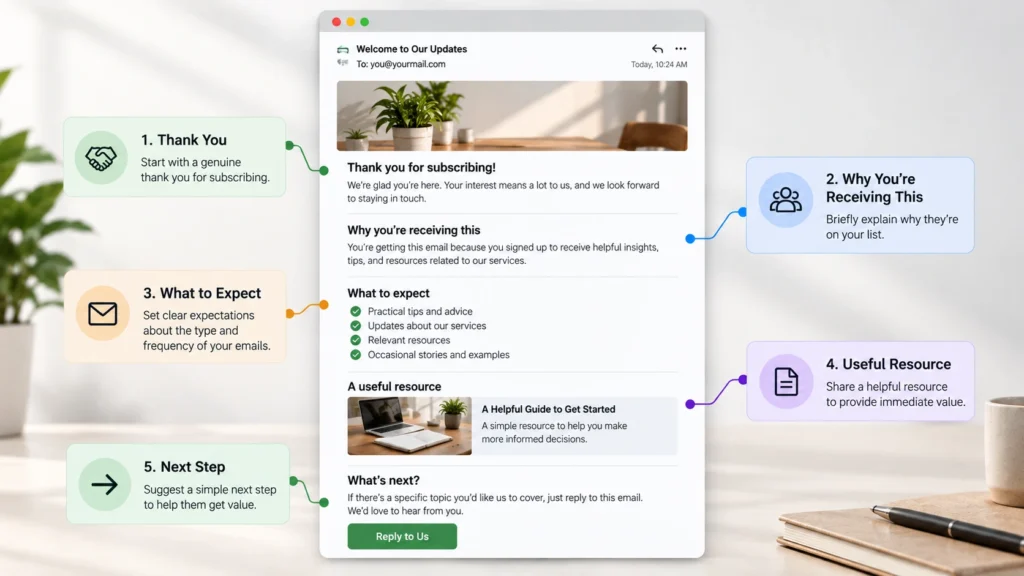
Be specific.
Instead of:
“Subscribe for business updates.”
Try something closer to:
“Every two weeks, I’ll send practical ideas for improving your website, email marketing, and online customer journey.”
Now the subscriber has context.
They know:
- The topic
- The approximate frequency
- The type of value
- The general reason to stay subscribed
This is especially important when your service business covers several areas.
If you offer web design, SEO, email marketing, branding, and social media, your newsletter should not feel like a random mixture of all five.
Give subscribers a clear editorial promise.
Expectations should match the signup form
This is one of the first things worth checking when reviewing an email system.
Look at the signup form.
Then look at the welcome email.
Then look at the next three emails.
Do they feel like one connected experience?
If the signup form promises:
“Get one practical marketing tip every week.”
but the welcome email immediately promotes a service package, you have changed the relationship before it has even started.
If the signup form offers a downloadable checklist but the first email only says “Welcome,” you have failed to deliver the immediate value that created the signup.
The promise and the follow-through should match.
Give them something useful immediately
This does not have to be a discount.
For professional services, educational value can often make more sense.
You could provide:
- The promised guide
- A checklist
- A short tutorial
- A useful article
- A diagnostic worksheet
- A practical template
- A short video
- A simple recommendation
The first email should give subscribers a reason to think:
“Good. This is exactly what I signed up for.”
That is a much stronger beginning than trying to force a consultation request immediately.
Your welcome email should introduce your point of view
Professional service businesses sell expertise.
That means your email should eventually communicate how you think.
The welcome email can start that process.
For example:
A web strategist might say, “I focus on fixing the business problem behind a website before recommending a redesign.”
An accountant might say, “My emails will focus on helping small business owners understand financial decisions without unnecessary jargon.”
A consultant might say, “I prefer practical frameworks you can apply immediately rather than long theoretical explanations.”
These statements are useful because they define the type of expertise the subscriber will experience.
Do not introduce every service
A common mistake is treating the welcome email as an “About Us” page.
That usually produces a long introduction.
“We are a full-service agency offering…”
Then comes a list.
Then another list.
Then several buttons.
Then a consultation CTA.
The subscriber has barely arrived.
Give them a reason to stay before giving them a reason to buy.
Your expertise should become visible through the usefulness of the emails themselves.
One CTA is usually enough
If the welcome email delivers a resource, the CTA can simply be:
Get the guide
If the email introduces your most useful article:
Read the article
If you have created a highly relevant first step for a service:
See how the process works
The CTA should make sense in the context of the email.
Mailchimp recommends keeping the next action clear and avoiding unnecessary competing actions in the first email.
Think in terms of a customer journey
A useful welcome sequence might look like this:
Email 1: Orientation
Thank the subscriber and explain what to expect.
Email 2: Education
Solve one relevant problem.
Email 3: Perspective
Show how you think about a common business challenge.
Email 4: Evidence
Share a case study, example, customer story, or practical demonstration.
Email 5: Next step
Offer an appropriate action based on what the subscriber has shown interest in.
This structure is not a universal formula.
Some businesses need three emails.
Others may need four.
Some may need only one.
Adobe’s guidance suggests that a three-to-five-email welcome series can help distribute information while keeping individual messages concise.
The important part is progression.
Do not send five versions of “Here are our services.”
Your first email should sound like your future emails
Consistency matters.
If your welcome email sounds like a friendly conversation but the second email becomes corporate and overly promotional, the subscriber may feel that the first impression was misleading.
The tone should be recognizable.
If your brand is:
- Practical
- Friendly
- Direct
- Educational
let the welcome email sound that way.
If your emails are normally detailed and analytical, give subscribers a small taste of that.
The welcome email should not be a performance.
It should be an introduction to the actual experience.
What professional service businesses can promise
Your promise should be realistic.
You can promise:
- A weekly practical tip
- A monthly industry analysis
- New articles
- Useful resources
- Occasional business insights
- Case studies
- Educational content
Avoid promises that your team cannot maintain.
Consistency is part of trust.
If you say weekly and regularly disappear, the subscriber learns that your promises are flexible.
That is not the impression you want your email marketing to create.
Use the signup source when possible
Not every subscriber arrives for the same reason.
Someone downloading a website audit checklist probably has different interests from someone joining a general business newsletter.
Someone who subscribes after reading an SEO article has already shown a topic preference.
If your system allows it, use that context.
Even a simple segmentation structure can help.
For example:
Website interest
Email marketing interest
SEO interest
General business growth
You do not need dozens of segments.
You need enough context to avoid sending obviously irrelevant messages.
Mailchimp recommends segmentation based on subscriber interests and behavior to make future messages more relevant.
What should happen after the welcome email?
This is the part many businesses forget.
The welcome email exists inside a system.
You should know what happens next.
Does the subscriber enter a weekly newsletter?
Do they receive a short educational series?
Are they moved into a topic-specific sequence?
Do they receive a consultation invitation later?
What happens if they click a particular resource?
What happens if they never engage?
You do not need an advanced automation map to begin.
But you should know where the welcome email leads.
The welcome email is also a test of your positioning
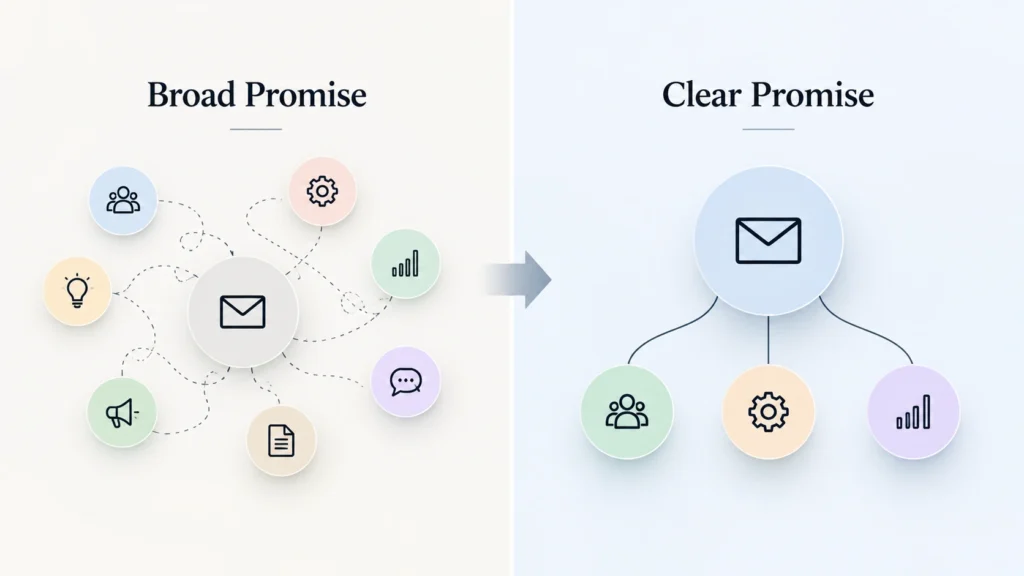
If you cannot explain what subscribers should expect from your emails in one or two clear sentences, there may be a positioning problem.
That does not necessarily mean your business positioning is bad.
It may simply mean your email strategy is too broad.
Try completing this sentence:
“When you join my list, you can expect…”
If the answer becomes a long list of unrelated topics, narrow it.
For example:
“When you join my list, you can expect practical ideas for improving your website and converting more of the traffic you already have.”
That gives the subscriber a clear mental model.
Compliance should not be forgotten
Professional service businesses sometimes think of a welcome email as a harmless personal note.
If the message is commercial, email laws can still apply.
The FTC’s CAN-SPAM guidance says commercial email must meet requirements including accurate header information, non-deceptive subject lines, a valid physical address, and an opt-out mechanism.
The exact legal requirements depend on the message and applicable jurisdiction, so businesses should not treat a welcome automation as automatically exempt from email-marketing responsibilities.
Good email strategy and responsible email practices should work together.
What to test
Once your welcome email is running, do not immediately rebuild the entire sequence.
Test one meaningful variable at a time.
You might test:
- Subject line
- Opening sentence
- Main CTA
- Resource presentation
- Email length
- Timing
- Segmentation
- The order of the first few emails
Then look at the metric that matters for that specific test.
If your welcome email’s job is to deliver a guide, measure whether people click and access the guide.
If the job is to start conversations, measure replies.
If the job is to introduce a service, look at meaningful visits or inquiries rather than simply celebrating opens.
A practical audit for your current welcome email
Open your existing welcome email and ask:
1. Is the reason for the email obvious?
2. Does it remind the subscriber what they signed up for?
3. Does it explain what future emails will contain?
4. Does it give them something useful?
5. Does the tone match future emails?
6. Is there one clear next step?
7. Does the email make sense for the source where the subscriber joined?
8. Does the sequence after this email make sense?
9. Are you making promises you can actually keep?
10. Are the applicable email requirements being handled correctly?
If the answers are mostly yes, you probably do not need to make the system more complicated.
The business-growth perspective
A subscriber is not simply an email address.
They are someone who has indicated that your business is relevant enough to deserve future attention.
That attention has value.
The welcome email is where you begin showing whether you understand how to use it responsibly.
A professional service business does not need to impress a new subscriber immediately.
It needs to be clear.
Clear about what it does.
Clear about what it will send.
Clear about how often it will communicate.
Clear about what the subscriber will get from staying.
And clear about what happens next.
That clarity can become a small but important part of the overall customer journey.
The practical takeaway
If your current welcome email says little more than “Thanks for subscribing,” I would not immediately add more graphics, more buttons, or more automation.
First, explain the relationship.
Tell subscribers why they are hearing from you.
Tell them what they will receive.
Deliver the value you promised.
Give them one useful next step.
Then let the rest of your email strategy build from that foundation.
The right welcome email is not the one that says the most.
It is the one that makes the subscriber understand why staying subscribed will be worthwhile.