
A potential customer can be ready to hire someone and still never find your business.
They may search for “plumber near me,” “family lawyer in Austin,” “roof repair in Dallas,” “med spa near me,” or another service followed by a location. At that moment, the quality of your service is not the first thing being evaluated. Your visibility is.
That is where local SEO becomes important. It helps your business become easier to discover when people are searching for the services you provide in the areas you actually serve. But local SEO is not simply about adding a city name to your website or creating a Google Business Profile and waiting for results. It is a combination of accurate business information, relevant website content, local signals, customer trust, and a clear connection between what people search for and what your business offers.
For service businesses, that connection can directly influence whether a potential customer discovers you, visits your website, calls you, requests a quote, or chooses another provider.
What Local SEO Actually Means
Local SEO is the process of improving a business’s online presence so it can appear more prominently for searches connected to a specific location.
The important part is the relationship between service, search intent, and location.
Someone searching for “website designer” is making a different type of search from someone searching for “website designer in Miami.” The second search contains a stronger local signal because the person is looking for a provider connected to a particular area.
Local SEO helps search engines understand that connection.
For a service business, that can involve your Google Business Profile, website, service pages, location information, reviews, business details, and other signals that help search engines and customers understand who you serve and where you operate.
Why Service Businesses Need a Local Search Strategy
Service businesses have an important difference from many online businesses: location can be part of the buying decision.
A customer may not want the best provider anywhere in the world. They may want the right provider within a reasonable distance from their home, office, property, or service area.
That makes local visibility particularly important for businesses such as:
- Plumbers and electricians
- Roofers and contractors
- Dentists and healthcare practices
- Lawyers and accountants
- Salons, spas, and aesthetic clinics
- Cleaning and maintenance companies
- Real estate professionals
- Home improvement businesses
- Consultants and local professional services
A strong website alone does not guarantee local visibility. Your website needs to be supported by accurate local business information and a presence that makes sense for the areas and services you actually serve.
How Google Looks at Local Search
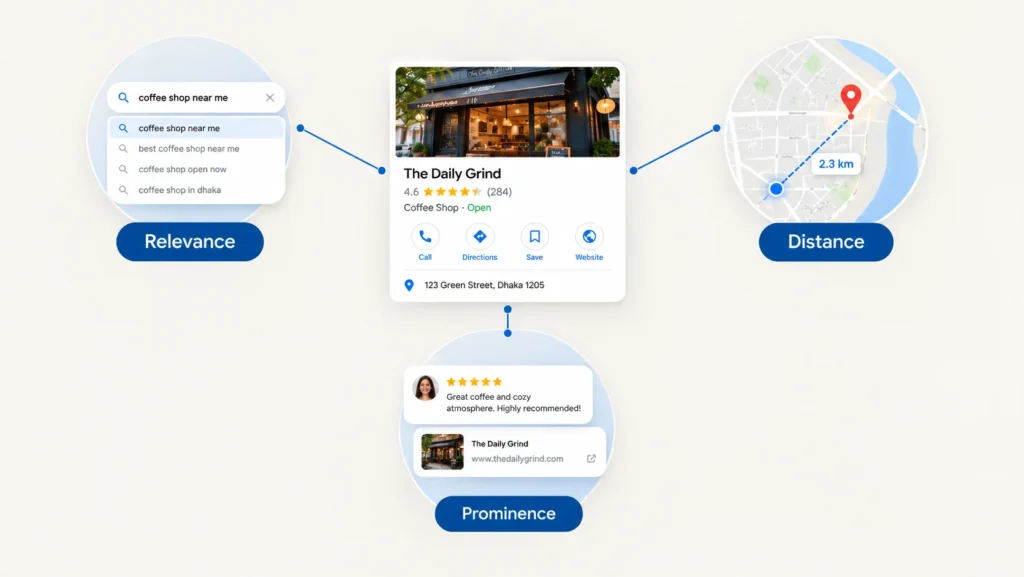
Google explains that local results are primarily influenced by relevance, distance, and prominence. Relevance is about how well a business matches the search, distance considers how close the business is to the searcher’s location, and prominence relates to how well-known or established the business is.
These factors matter because local SEO is not simply a competition to insert more keywords into a page.
Imagine two businesses offering the same service. One has an accurate and complete business profile, clearly explains its services, has a useful website, and has genuine customer reviews. The other has inconsistent information, a vague website, and very little useful business information.
The first business gives search engines and potential customers much more context to work with.
Relevance
Your business needs to clearly communicate what you do.
If your website simply says “We provide professional solutions,” that does not tell a potential customer much. A service page explaining exactly what you offer, who you serve, and what the customer can expect provides much stronger context.
Distance
Location matters because local searches are connected to where the customer is searching from or the location included in the search.
That is why a business may appear prominently for a local search in one area but not have the same visibility several cities away.
Prominence
Prominence is connected to how well-known a business is. Google notes that information such as links from other websites and customer reviews can contribute to prominence.
This is one reason local SEO should not be treated as a single website optimization task. It is an ongoing process of building a credible and consistent online presence.
Your Google Business Profile Is Important, But It Is Not the Whole Strategy
For eligible local businesses, a Google Business Profile acts as an important connection between the business and Google Search and Maps. It can display information such as your business name, website, phone number, hours, services, photos, and reviews.
But creating the profile is only the beginning.
Your information needs to be accurate and complete. Your category needs to represent the actual business. Your services should be understandable. Your hours should remain current. Your website should support the same business information rather than contradicting it.
Think of your Business Profile as one part of your local presence rather than your entire local SEO strategy.
Your Website Still Matters
One common mistake is treating the Google Business Profile as a replacement for a website.
It is not.
When someone discovers your business through local search, they may still visit your website before contacting you. They want to know:
- What exactly do you offer?
- Do you serve my area?
- Is this the right type of provider for my problem?
- What does your process look like?
- Can I trust this business?
- How can I contact you?
Your website should answer those questions quickly.
A service page should not simply exist because you want another page indexed. It should explain the service clearly and help the visitor decide whether your business is relevant to them.
Service Area Businesses Need a Different Approach
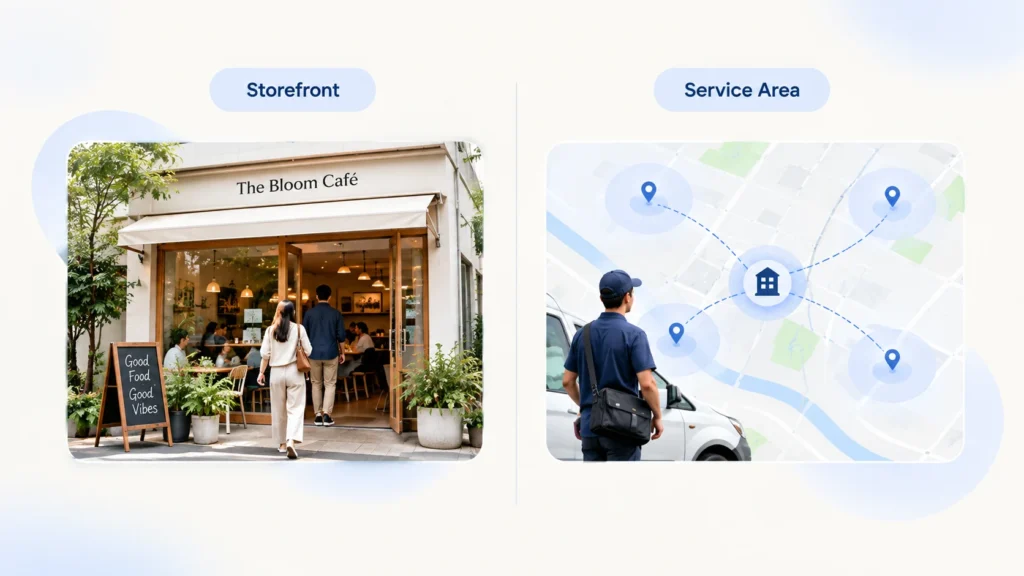
Not every service business has a storefront that customers visit.
A plumber, electrician, cleaning company, mobile beauty professional, or contractor may travel to customers instead. Google treats these businesses as service-area businesses or, in some cases, hybrid businesses.
This distinction matters.
If you operate as a service-area business, your profile should represent the areas you genuinely serve. Google allows service areas to be specified using cities, postal codes, or other defined areas rather than simply drawing an arbitrary radius.
That means you should not create a local presence for every nearby city simply because you want to rank there.
Your location strategy should reflect your actual operation.
Local SEO Starts With Clear Service Pages
Suppose you operate a roofing company.
A single page titled “Services” that lists roof repair, roof replacement, inspections, and maintenance may not provide enough context for either the customer or search engine.
Separate, useful service pages can make the business easier to understand.
For example:
- Roof Repair
- Roof Replacement
- Roof Inspection
- Emergency Roofing
- Commercial Roofing
Each page can explain the specific problem, service process, relevant considerations, service area, and next step.
The goal is not to create dozens of thin pages. It is to create useful pages around services that your business genuinely provides.
That distinction is important because local SEO should make your business clearer, not simply make your website bigger.
Location Pages Need a Real Purpose
Location pages can also be useful when a business genuinely serves multiple locations.
But there is a major difference between a useful location page and a page where only the city name has been changed.
A useful location page should provide genuine information about serving that area. It should make sense to a person who lives there, not just to a search engine.
For example, if a business genuinely serves both Dallas and Fort Worth, separate location content may make sense when each page provides useful information about the service in that market.
If you simply replace “Dallas” with “Fort Worth” across nearly identical pages, you are not creating a better customer experience.
Reviews Are About More Than Star Ratings
Reviews can influence how potential customers perceive a service business, and Google includes reviews among the information that can contribute to local prominence.
But the goal should not be to collect reviews simply as an SEO tactic.
A genuine review gives another potential customer evidence about the experience of working with your business.
That makes the quality and authenticity of the customer experience more important than trying to manufacture a large number of reviews.
You should also respond appropriately to reviews and treat them as part of your broader customer communication.
Consistency Matters Across Your Online Presence
Google can gather business information from several sources, including publicly available information from websites, third-party data, user contributions, and information provided through Business Profiles.
That makes consistency important.
Your business name, address, phone number, website, services, and other important information should not create unnecessary confusion across the web.
If your website says one thing, your Business Profile says another, and other listings contain outdated information, both customers and search engines have a less reliable picture of the business.
Technical SEO Has a Role Too
Local SEO is not completely separate from traditional SEO.
Your website still needs to be technically accessible, logically structured, mobile-friendly, and easy for search engines to understand.
For eligible local businesses, structured data can also help Google understand details about the organization and its location. Google specifically documents the LocalBusiness structured data type and recommends using the most specific applicable business subtype.
Structured data is not a shortcut to local rankings. It is better understood as a way of providing structured information about your business to search engines.
The fundamentals still matter first: useful content, accurate business information, strong service pages, good website structure, and a trustworthy customer experience.
What Local SEO Should Not Become
There is a temptation to turn local SEO into a keyword exercise.
That usually leads to awkward pages filled with phrases such as:
“Best plumber in Dallas plumber Dallas plumbing services Dallas plumber near me.”
That is not useful writing, and it does not create a better experience for someone trying to hire a plumber.
A stronger approach is to write naturally about the service, the problems customers have, the areas you serve, and the questions people need answered before contacting you.
Local relevance should be clear from the content, not forced into it.
A Practical Local SEO Framework for Service Businesses
If you are reviewing your local SEO today, start with the foundations rather than trying to optimize everything at once.
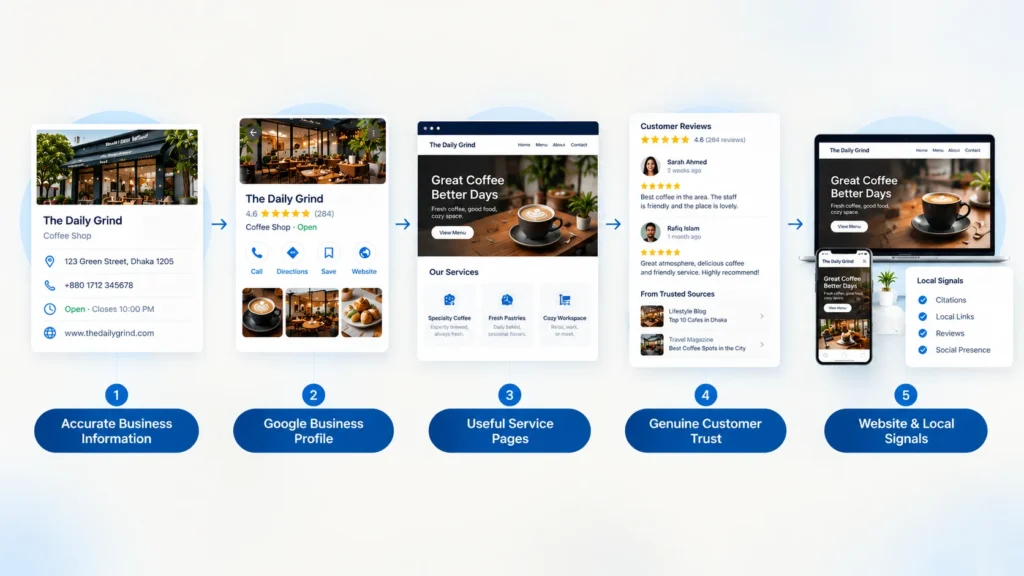
1. Make sure your business information is accurate
Check your business name, address or service area, phone number, website, hours, categories, and services.
2. Review your Google Business Profile
Make sure the profile represents the real business and the information matches what customers see elsewhere.
3. Improve your core service pages
Make each important service easy to understand. Explain what you provide, who it is for, where you provide it, and what the customer should do next.
4. Make your service area clear
If you travel to customers, clearly communicate the locations you genuinely serve rather than trying to appear everywhere.
5. Build genuine customer trust
Encourage legitimate customers to share their experience and respond professionally to reviews.
6. Review your website’s local signals
Look at your page titles, headings, contact information, service pages, location references, internal links, and structured data where appropriate.
7. Look beyond Google
Check whether important business information is accurate across other relevant platforms and websites. Local visibility is stronger when your overall online presence tells a consistent story.
The Real Purpose of Local SEO
Local SEO is often described as a way to “rank higher,” but that is only part of the picture.
The bigger goal is to become easier to discover when the right person is looking for the service you provide in an area you actually serve.
That changes how you approach the work.
Instead of asking, “How many local keywords can I put on my website?” ask, “What would someone need to see to understand that my business is the right local option for this service?”
That question usually leads to better decisions about your website, Google Business Profile, service pages, reviews, location information, and overall customer journey.
What Matters Most for Your Local Visibility
Local SEO works best when the different parts of your online presence support the same message. Your Business Profile should accurately represent your business. Your website should clearly explain your services. Your service areas should reflect where you actually work. Your reviews should represent genuine customer experiences. Your technical setup should make the site easy to understand and use.
You do not need to chase every local SEO tactic you see online. Start with the information customers need, make your business easy to understand, and build a consistent presence around the services and locations that genuinely matter to your business.
If you are unsure where your local visibility problem actually starts, reviewing the current customer journey before changing everything can save you from optimizing the wrong part of the system.