

A customer has already made the decision to buy from you. That does not mean the relationship is established yet.
The first few days after a purchase, booking, signup, project start, or service agreement can quietly shape how the customer understands your business. They are figuring out whether communication is clear, whether the process feels organized, whether your team does what it said it would do, and whether choosing you was actually the right decision.
That is why the first week deserves more attention than a generic “thank you for your business” email.
A good first-week customer experience is not about impressing someone with excessive communication or adding more features to the onboarding process. It is about removing uncertainty, delivering an early sign of value, and making it easy for the customer to know what happens next.
The first week is where expectations meet reality
Before someone becomes a customer, they have already formed expectations.
Your website, sales conversation, proposal, reviews, pricing, emails, social presence, and the promises made during the buying process all contribute to those expectations. Once the customer says yes, the first week becomes the point where those expectations meet the actual experience of dealing with your business.
That creates a simple but important test.
Does the experience after the sale feel consistent with the experience that convinced the customer to buy?
If the answer is yes, confidence can grow naturally. If the customer suddenly has to chase information, repeat details, wait without explanation, or figure out the process alone, the relationship can feel different almost immediately.
Customer onboarding is commonly described as the process of guiding a new customer from signup or purchase toward successfully using or receiving value from a product or service. IBM notes that onboarding can also shape the early impression that sets the tone for the broader relationship.
A good first week should answer five questions
Your customer should not have to wonder:
- Did my purchase or request go through?
- What happens next?
- Who is responsible for helping me?
- When should I expect the next step?
- What do I need to do now?
These questions sound basic, but many poor customer experiences come from leaving one or more of them unanswered.
Imagine a customer has just paid for a website project. They receive a payment confirmation, but nothing explains what happens next. They are unsure when the kickoff will happen, where to send their content, who they should contact, or when they will hear from the team.
Nothing may be technically broken.
The customer is still experiencing uncertainty.
And uncertainty creates unnecessary effort.
The first week should reduce customer effort
One of the most useful ways to evaluate a customer experience is to look at the amount of work the customer has to do.
Customer Effort Score, or CES, is specifically designed to measure how easy or difficult a particular interaction feels. Gartner’s research describes customer effort as a useful CX measure for identifying friction, while Salesforce explains that CES focuses on the effort involved in a specific customer interaction rather than overall satisfaction.
This gives business owners a practical question:
How much work are you asking the customer to do just to understand what is happening?
For example, compare these two experiences.
Experience A
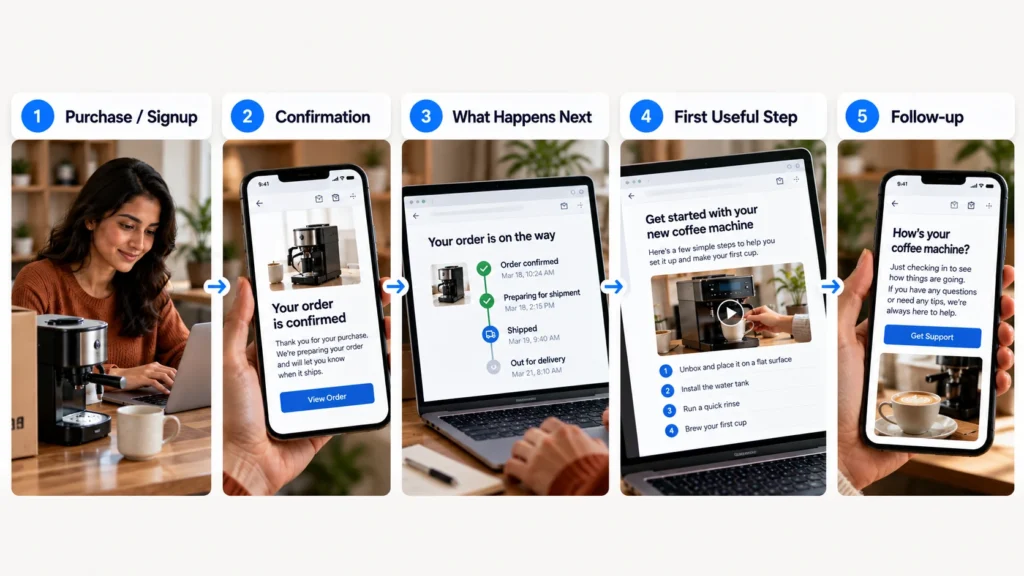
The customer receives confirmation, a named contact, the next milestone, a short checklist, and a clear expectation for when the business will respond.
Experience B
The customer receives a generic confirmation and then has to email, call, search previous messages, and ask several questions to understand what happens next.
The service itself may be identical.
The perceived experience is not.
Give customers a small but meaningful win
A good first week does not necessarily need a dramatic result.
It needs evidence that the relationship is moving in the right direction.
For an ecommerce business, that might mean clear delivery communication and useful product guidance. For a consultant, it could be a well-organized kickoff and a clear first recommendation. For a service provider, it might be completing the first agreed step exactly when promised. For a software business, it may be helping the customer complete one meaningful workflow rather than showing them every available feature.
The important idea is early value.
Research published in Manufacturing & Service Operations Management examined a field experiment involving 2,673 customers of a public cloud infrastructure provider. Customers who received proactive guidance on basic features experienced lower first-week churn and fewer questions during the first week. The study was specific to that service context, so it should not be treated as a universal benchmark for every business, but it provides useful evidence that early customer education can influence the beginning of a customer relationship.
The lesson is not “send more information.”
It is “help the customer reach a useful first outcome.”
Do not confuse onboarding with information overload
This is where many businesses unintentionally make the first week harder.
They send a welcome email, a PDF, a product guide, a list of policies, several tutorial links, a calendar invitation, an account setup request, a survey, and three more emails explaining everything the customer might eventually need.
Technically, the customer has been given a lot of support.
Practically, they may not know where to start.
A better approach is to separate what the customer needs now from what they may need later.
During the first week, prioritize:
- The immediate next step
- The information needed to complete it
- The person or channel responsible for support
- The first useful outcome
- A clear expectation for what happens afterward
Additional resources can remain available without competing for attention.
Make communication predictable
Customers do not necessarily need constant updates.
They need confidence that the business is paying attention.
If a project takes several weeks, a customer may be perfectly comfortable waiting as long as they understand the schedule. If a delivery is delayed, early communication can be more useful than silence followed by an apology. If a service requires information from the customer, explain exactly what is needed and why.
This is where a simple communication framework helps:
Confirm → Orient → Act → Update
Confirm: Tell the customer that the transaction, booking, project, or request has been received.
Orient: Explain what happens next and who is responsible.
Act: Give the customer one clear action when their input is genuinely required.
Update: Close the loop when the next milestone is reached or when circumstances change.
The exact channels can vary. Email, SMS, a customer portal, phone, or a personal message can all work. The important part is consistency.
The first week should feel personal without becoming manual
Personalization does not mean sending every customer a completely custom message.
It means making the communication relevant to the customer’s situation.
A new ecommerce customer may need product-use guidance. A consulting client may need a project brief. A new homeowner booking a service may need appointment details and preparation instructions. A B2B client may need information about contacts, access, timelines, and responsibilities.
The mistake is treating all of these customers as if they need the same onboarding sequence.
A useful first-week experience has a shared structure with relevant details.
That makes the process easier for the business to manage while still making the customer feel understood.

Look for the moments where customers become uncertain
If you want to improve the first week, do not start by asking, “What else can we send?”
Start by asking:
“Where does the customer currently have to stop and figure things out?”
Review the journey from the customer’s point of view.
Look at:
- What happens immediately after payment or signup
- The first confirmation message
- The first customer-facing instruction
- The first appointment or kickoff
- The first request for information
- The first support interaction
- The first delay or unexpected change
- The first moment when the customer receives value
These are the moments where friction often becomes visible.
Customer-effort research consistently emphasizes the importance of reducing unnecessary work during customer interactions. Gartner specifically frames high-effort experiences as a CX and service-cost issue, while Ipsos research has also examined the relationship between customer effort and loyalty outcomes.
What should you measure?
You do not need a complicated dashboard to understand whether your first-week experience is working.
Start with a few practical signals:
Time to first useful outcome
How long does it take the customer to experience the first meaningful benefit?
The definition will vary by business. For a service provider, it might be the first completed milestone. For ecommerce, it might be successful product use. For software, it could be completion of a core workflow.
Customer questions during the first week
Repeated questions are useful clues.
If customers repeatedly ask, “What happens next?” or “Where do I send this?” the problem may not be the customer. The process may simply be unclear.
First-week support issues
Look for repeated friction rather than isolated incidents.
One unusual problem is different from dozens of customers encountering the same step.
Customer feedback
You can ask a simple question after the first meaningful interaction:
“How easy was it to get started?”
If you use a formal Customer Effort Score, keep the measurement tied to a specific interaction rather than treating it as a replacement for broader customer satisfaction or relationship metrics. Salesforce describes CES as a transactional measure designed to evaluate the ease of a particular interaction.
A practical first-week framework
A useful starting point for many businesses is:
| Stage | Customer needs | Business responsibility |
| Day 0 | Confirmation and reassurance | Confirm the transaction or agreement |
| Day 1 | Orientation | Explain what happens next |
| Days 2–3 | Clear action | Help the customer complete the next meaningful step |
| Days 3–5 | Early value | Deliver or demonstrate something useful |
| Days 5–7 | Confidence | Confirm progress and explain the next phase |
This is not a universal schedule.
A physical product, a consulting engagement, a recurring service, and a software subscription will all have different customer journeys. The framework is useful because it forces the business to think about the customer’s progression rather than simply the number of emails being sent.
The best first-week experience may be surprisingly simple
A strong customer experience does not require a complicated customer portal, an elaborate automation system, or a dozen onboarding emails.
Sometimes the biggest improvement comes from fixing one confusing step.
Maybe customers are unsure who to contact.
Maybe they do not know when the project starts.
Maybe they have to repeat information they already provided during the sales process.
Maybe they receive a confirmation but no explanation of what happens next.
Maybe your team knows the process perfectly, but the customer cannot see it.
Those are not necessarily technology problems.
They are experience-design problems.
What a Good First Week Should Leave Behind
By the end of the first week, the customer should ideally feel that the business is organized, responsive, and clear about what happens next. They do not need to know everything about your company, product, or service yet. They need enough confidence to understand that the decision they made is being handled properly.
That is the real purpose of early customer experience design. Not more messages. Not more features. Not unnecessary personalization. Less uncertainty, less effort, and a clear path toward the first meaningful result.
If your business is reviewing its customer journey, start by mapping the first seven days from the customer’s perspective. Find the points where they wait, wonder, repeat themselves, or ask questions that your process should already answer. Those moments are often more valuable to fix than adding another layer of technology.