

A local business can tell people that it is reliable, friendly, experienced, affordable, professional, and customer-focused.
The problem is that almost every competitor can say the same thing.
The harder question is:
Can a potential customer see those qualities in action?
That is where customer stories become useful.
A customer story takes an ordinary statement such as “We provide great service” and gives it context. Instead of asking visitors to simply believe the business, it shows them what happened when a real customer needed help.
For local businesses, that can be particularly valuable because the buying decision often involves uncertainty.
A homeowner may wonder whether a contractor will communicate properly. A salon customer may wonder whether the experience will match the website. A local consultant may need reassurance that the person understands businesses like theirs.
A customer story can help answer those questions before the customer ever makes contact.
Why local businesses have an advantage with customer stories
Large companies often have sophisticated marketing teams, extensive advertising budgets, and polished campaigns.
A local business has something different.
It can show real relationships.
The owner may know the customer personally. The team may have worked through a specific problem with them. The business may understand the local context better than a large generic provider.
That human element can become part of the marketing without turning the business into a personal brand.
A customer story can show:
- How the business communicates
- How it handles uncertainty
- How it solves problems
- What the process feels like
- What customers appreciate
- What the business values
Those details are much harder for a competitor to copy than generic adjectives.
What makes a customer story useful?
A useful story does not need to be dramatic.
In fact, ordinary experiences can be extremely valuable.
Consider a local HVAC company.
A weak testimonial might say:
“Excellent company. Very professional.”
A stronger customer story might explain that the homeowner noticed inconsistent temperatures, did not know whether the issue required a repair or replacement, contacted the company for an assessment, appreciated the explanation of the available options, and felt more confident about the final decision.
Notice what changed.
The business did not suddenly become more impressive.
The story simply became more informative.
Build the story around the customer’s decision
A common mistake is to structure every story around what the business did.
“We arrived at 9 AM. We inspected the system. We completed the work. We cleaned up.”
That is useful operational information, but it may not be the most interesting part.
The potential customer is usually more interested in:
“What was this person trying to figure out, and what made them comfortable choosing this business?”
That means the customer’s decision deserves attention.
Ask:
- What problem led you to look for help?
- What were you comparing?
- What made you contact us?
- Was there anything you were concerned about?
- What helped you feel comfortable moving forward?
- What part of the process stood out?
Those answers can reveal your real differentiators.
Look for the details competitors cannot easily copy
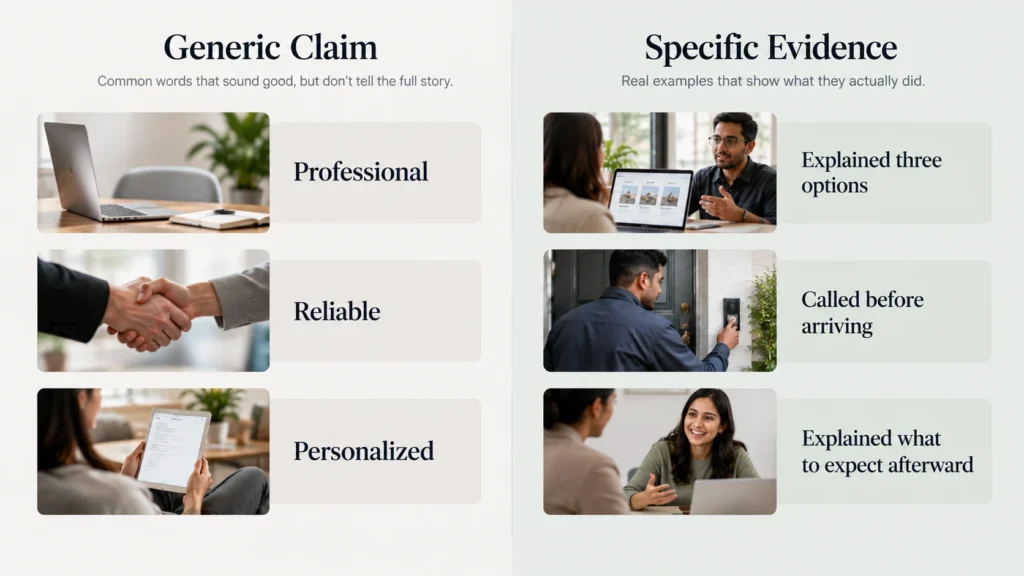
Suppose three local businesses all claim:
“Personalized service.”
That phrase is weak because it does not explain anything.
But one customer says:
“They took the time to explain three options and told me which one they would choose if it were their own home.”
Now we have something concrete.
The business may have a genuine positioning opportunity around clear, honest guidance.
Another customer might say:
“I appreciated that they called me before arriving instead of simply showing up.”
That reveals communication.
Another might say:
“The team explained what they had done before leaving, so I knew what to watch for afterward.”
That reveals education and follow-through.
These small details can become powerful website messaging because they describe behavior rather than adjectives.
Customer stories can improve your website
Customer stories should not be placed randomly on a homepage simply because someone said they are good for conversion.
Think about the customer’s journey.
A visitor on your homepage may need a general reason to trust you.
A visitor on a specific service page has a more specific question.
If someone is reading a residential roof-repair page, a story about a homeowner who had a similar issue may be more useful there than a generic testimonial at the bottom of the homepage.
This creates a simple principle:
Put the story close to the question it helps answer.
| Customer concern | Useful story angle |
| “Will they understand my problem?” | Similar customer situation |
| “What happens after I contact them?” | Process-focused story |
| “Can I trust their recommendation?” | Decision-making story |
| “Will the service disrupt my day?” | Experience-focused story |
| “What happens afterward?” | Outcome and follow-up story |
The goal is not to fill pages with testimonials.
The goal is to remove uncertainty.
Use different story formats
Not every customer experience needs to become a long case study.
Short customer quote
Useful for a homepage, service page, or landing page.
Customer story
A few paragraphs explaining the situation and experience.
Detailed case study
Useful for larger projects or services involving significant research and investment.
Video story
Useful when the customer is comfortable speaking naturally about the experience.
Before-and-after story
Useful when the transformation is visually meaningful and genuinely represents the customer’s experience.
Process story
Useful when potential customers are mainly uncertain about what happens after they contact the business.
The format should match the complexity of the decision.
Do not write the customer’s story for them
There is a temptation to take a customer’s short message and turn it into an impressive marketing paragraph.
Be careful.
If the customer says:
“I was nervous about the appointment, but everyone explained things clearly and I felt comfortable.”
Do not turn that into:
“Our world-class team delivered an unparalleled experience that exceeded every expectation.”
The second version may sound polished.
It also sounds less believable.
Customer stories work because they sound like experiences, not advertisements.
Edit for clarity, but preserve the substance and character of what the customer actually said.
Permission matters
There is a difference between receiving feedback and receiving permission to publish a detailed customer story.
If you want to use a customer’s name, image, business name, project information, video, screenshots, or detailed results, make sure you have appropriate permission for that use.
This becomes especially important when the story contains personal or sensitive information.
The safest approach is straightforward:
Tell the customer what you want to publish, where you intend to publish it, and what information you would like to include.
Then get appropriate permission before publishing.
Never trade trust for a stronger marketing story
A local business does not need fictional drama.
Do not invent customer problems.
Do not exaggerate outcomes.
Do not make one unusual result sound normal.
Do not publish a story that changes what the customer actually experienced.
The FTC’s current guidance on reviews and testimonials emphasizes truthful experiences and warns against deceptive or misleading practices.
The FTC’s Consumer Reviews and Testimonials Rule provides additional detail on fake, false, and deceptive review and testimonial practices.
This is not simply a legal consideration.
It is a brand consideration.
If customers discover that a business has exaggerated their experiences, the marketing may create the opposite of its intended effect.
Build a customer-story collection process
If you want customer stories consistently, do not wait for inspiration.
Build a simple process.
Step 1: Identify useful customer experiences
Look for customers who represent important services, customer types, or common problems.
Step 2: Ask specific questions
Do not simply ask for “a testimonial.”
Ask about the problem, decision, experience, and outcome.
Step 3: Organize the responses
Keep a simple internal record of useful customer feedback and the permissions associated with it.
Step 4: Identify recurring themes
Look for repeated words and ideas.
You may discover that customers repeatedly mention speed, communication, explanation, friendliness, reliability, or another quality.
Step 5: Turn the strongest stories into content
Use the appropriate format and placement.
Step 6: Review periodically
Customer stories should support the current business positioning.
If the business changes its services or target customers, the story library should evolve too.
The best stories can influence more than marketing
There is an operational benefit here too.
Suppose ten customers independently mention that they appreciated the same part of your process.
That is information.
Maybe your team has developed a strength that the business has never clearly communicated.
Maybe customers repeatedly ask the same question.
Maybe they are confused about the same stage of the process.
Maybe they value something you never considered a major differentiator.
Customer stories can therefore become a source of business insight.
They can influence website copy, service descriptions, FAQs, onboarding, follow-up emails, and even how your team explains the service.
A practical customer-story template
For a local business that wants to start today, this is enough:
Customer situation: What problem brought the customer to you?
Concern: What were they unsure about?
Decision: Why did they choose your business?
Experience: What happened during the process?
Outcome: What changed?
Customer reflection: What did they value most?
That structure gives you a story without forcing the experience into a dramatic marketing formula.
Final thought
A local business does not need hundreds of testimonials to appear trustworthy.
It needs the right evidence in the right context.
A handful of detailed, honest customer stories can show potential customers what your business actually feels like to work with.
That is more useful than simply telling people that you are “professional.”
When planning your website or content strategy, ask a slightly different question:
“Which customer experience would help the next customer understand what it is like to choose us?”
That question will usually produce better content than:
“How can we get more testimonials?”