

A business owner can look at the same homepage every day and still miss a basic messaging problem.
The words make sense because the owner already knows the business.
The customer does not have that advantage.
That is why changing website copy should not always begin with writing. Sometimes it should begin with testing.
Before rewriting your homepage headline, changing your service descriptions, or redesigning an entire landing page, find out what people currently understand.
What are customers actually supposed to understand?
A useful value proposition should give the visitor enough context to understand the offer and decide whether it is relevant.
For most service businesses, that means answering some version of:
- What is this?
- Who is it for?
- What problem does it address?
- What outcome can I expect?
- Why might I choose this instead of another option?
The exact wording will vary by business.
A local plumber, a business consultant, a medical practice, and a web designer should not communicate value in the same way.
But the testing principle remains useful.
Start with the current version
Do not redesign first.
Take the current homepage, landing page, service page, advertisement, or sales message and test it as it exists today.
Show it to people who resemble the audience you want to attract.
Then ask them to interpret it without assistance.
A useful opening question is:
“What do you think this business offers?”
The important part is what comes after the question.
Stay quiet.
Do not correct them.
Do not explain the business.
Do not guide them toward the answer.
Their interpretation is the evidence you are looking for.
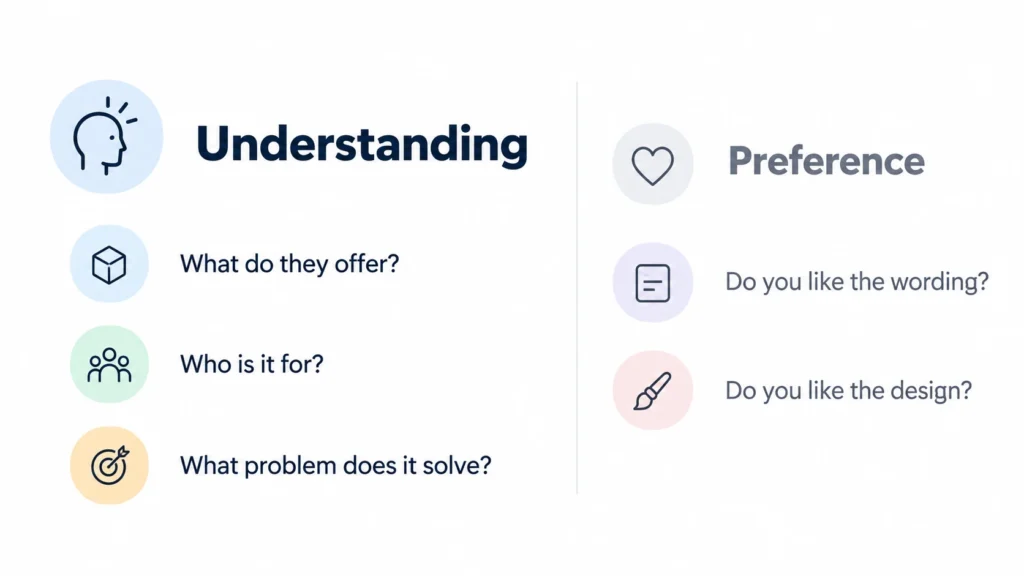
Test understanding, not personal preference
A common mistake is asking:
“Do you like this headline?”
That can be useful later, but it is not the first question I would ask.
A customer can dislike a perfectly clear headline.
A customer can also like a vague headline.
Neither answer tells you whether the message is doing its basic job.
Instead, test whether the person can explain the offer in their own words.
Ask:
What do you think they sell?
Who do you think this is for?
What problem do you think they solve?
What would you expect to get from them?
What would you do next?
These questions create much more useful feedback.
Do not explain the message while testing it
This sounds obvious, but it is one of the easiest mistakes to make.
Imagine someone says:
“I am not sure what this company does.”
The business owner responds:
“They help small businesses redesign outdated websites and improve conversions.”
Now the customer says:
“Oh, okay. That makes sense.”
It feels like the problem has been solved.
It has not.
The customer understood the explanation.
The website did not create that understanding on its own.
If the test is designed to evaluate the message, keep your explanation out of the process.
Look for repeated misunderstandings
One person’s interpretation may be unusual.
A pattern is more useful.
Suppose six relevant participants review the same page and four of them describe the business as a marketing agency when you intended to position it as a website design specialist.
That is meaningful.
Maybe the wording is too broad.
Maybe the service list is dominating the main message.
Maybe the headline focuses on a feature instead of the outcome.
Maybe the visual hierarchy is drawing attention to the wrong information.
The test does not necessarily tell you exactly how to fix the problem.
It tells you where the problem may be.
Test the words customers naturally use
Listen for language that appears repeatedly.
Customers may not describe your service using your preferred industry terminology.
That can be useful.
Suppose a company uses:
“Integrated customer acquisition infrastructure.”
Customers might consistently say:
“They help businesses get more inquiries from their website.”
The second phrase may be much easier to understand.
You do not have to copy it word for word.
But repeated customer language can reveal how the market naturally describes the value.
That can influence your website copy, service descriptions, ads, email messaging, and even how you explain the business in sales conversations.
Test the promise separately from the wording
A clear message is not necessarily a strong value proposition.
Imagine a business says:
“24-hour emergency plumbing service.”
A visitor understands it immediately.
Excellent.
But another question remains:
Does the target customer care about that promise?
For an emergency customer, probably.
For someone planning a bathroom renovation three months from now, perhaps not.
This is why validation should happen at multiple levels.
First:
Do people understand the offer?
Then:
Does the offer matter to them?
Then:
Does the offer influence their decision?
Those are different questions.
Use simple landing-page tests when appropriate
If your website receives meaningful traffic, you can test different versions of a value proposition and observe what visitors do.
Depending on the business, you might compare:
- Headline variations
- Subheadings
- Offer descriptions
- CTA wording
- Service positioning
- Benefit-focused versus feature-focused messaging
But do not treat one metric as the entire answer.
A higher click-through rate is not automatically a better value proposition if it brings the wrong visitors.
A higher inquiry rate is not automatically better if the leads are poorly qualified.
The test should connect to the actual business objective.
Test the next action
One of the strongest practical questions is:
“What would you do next?”
If someone understands your offer but cannot identify what to do next, the page may have a journey problem.
For example:
“I understand they build websites, but I would probably look for examples first.”
That tells you something.
Perhaps the portfolio should be easier to find.
Another person might say:
“I would want to know how much it costs.”
That could suggest a pricing or qualification question.
Another might say:
“I would contact them.”
That indicates a different level of readiness.
You are learning not only whether the value proposition is understood, but what understanding leads to.
Test with people who resemble real customers
Do not treat every opinion equally.
If you sell B2B accounting services, feedback from people with no connection to business finance may be interesting, but it is not the same as feedback from your target buyer.
If you run a local salon, test with people who could realistically book the services.
If you sell professional consulting, test with people who resemble the type of decision-maker you want to reach.
The closer the participant is to the real customer, the more carefully you can interpret the result.
Combine interviews with behavior
Interviews can reveal what people think.
Behavior can reveal what people do.
Both have a place.
Strategyzer recommends testing value propositions through customer interactions and experiments rather than relying only on what customers say. Its testing framework moves from validating customer jobs, pains, and gains toward testing the proposed offer and willingness to pay.
For a website, behavioral evidence might include:
- Which CTA gets attention
- Whether visitors reach important service pages
- Whether qualified visitors start an inquiry
- Whether users abandon the page before understanding the offer
- Whether one positioning message produces stronger qualified engagement
Again, the right signal depends on the business.
Change one important variable at a time
If you change your headline, service structure, CTA, page layout, pricing, images, and navigation at the same time, you may improve the page without learning why.
A more disciplined approach is to identify the assumption you want to test.
For example:
“Visitors do not understand that this service is specifically for local businesses.”
Now you have something to investigate.
You can test a clearer audience statement without changing the entire page.
That makes the learning more useful.
A practical value proposition test for a small business
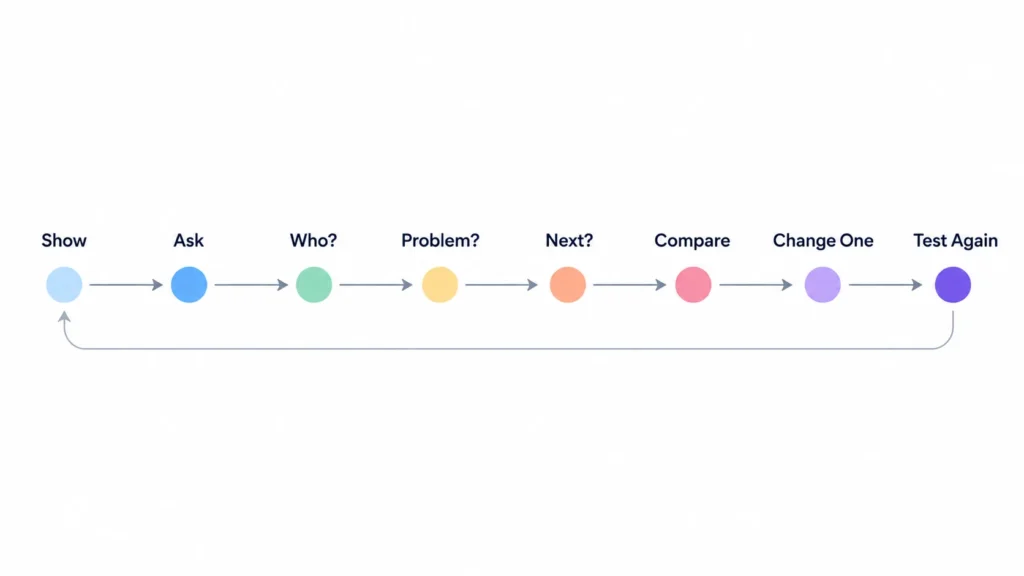
If you want a simple process, start here.
Step 1: Show the current message
Use the actual homepage or landing page.
Step 2: Ask what they think you offer
Do not explain anything.
Step 3: Ask who they think it is for
This tests positioning.
Step 4: Ask what problem they think it solves
This tests perceived value.
Step 5: Ask what they would do next
This connects understanding with customer action.
Step 6: Compare answers
Look for patterns rather than isolated comments.
Step 7: Change one important assumption
Do not redesign everything.
Step 8: Test again
The goal is learning, not finding a perfect headline on the first attempt.
Know when the problem is not your value proposition
This is important because businesses sometimes blame messaging for everything.
A customer may understand your offer perfectly and still not buy.
The reason could be:
- Price
- Timing
- Lack of trust
- Weak proof
- Poor reviews
- Wrong audience
- Complicated checkout
- Limited availability
- Stronger competition
- Unclear next step
So if your testing shows that customers understand the value proposition, do not keep rewriting it simply because conversions are low.
Find the actual bottleneck.
That is a much better use of the evidence.
The goal is not perfect wording
There is a temptation to treat value proposition work as a copywriting exercise.
It is more than that.
Good wording matters.
But the larger question is whether the market understands and values what the business is offering.
That requires testing.
You do not need a huge research department to start.
You can begin with a small group of relevant people, a few carefully chosen questions, and one clear assumption you want to investigate.
The most useful outcome may not be a better headline.
It may be discovering that customers value something different from what you thought.
That is valuable information too.
If your website is not producing the response you expect, I would test the message before immediately redesigning the page. Find out what customers think you offer, what they believe it is for, and what they would do next. Once you understand that gap, the design and copy decisions become much easier.