

A domain name is one of those decisions that can look trivial until you have to live with it.
You may find a good business name, check the domain, and discover that the .com is unavailable.
Then the alternatives appear.
.co.
.net.
Maybe a longer .com.
Maybe a completely different business name.
At that point, it is tempting to choose whichever option is available and move on.
That is usually too quick.
For a small business, the domain should support the brand, not simply give you an address for the website.
The First Question Is Not “Which Extension Is Best?”
The first question is:
Which domain gives the business the strongest overall identity?
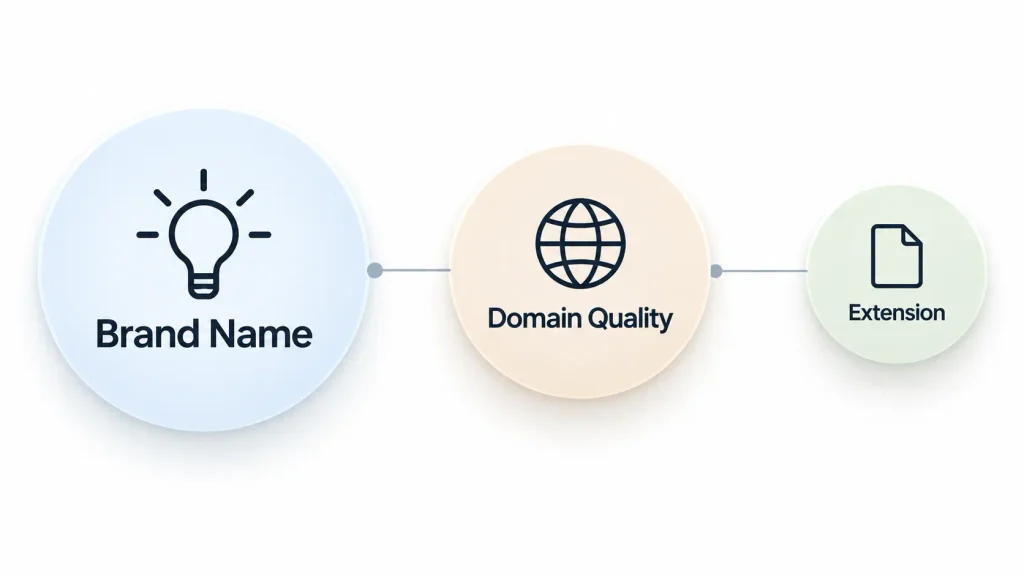
That includes the second-level name and the extension.
A short, memorable .co can be stronger than a long, awkward .com.
A clean .net can be perfectly reasonable for a technology company.
And a great .com can still be a poor choice if the name is difficult to spell or creates confusion with another business.
So the extension should be evaluated as part of the complete domain.
What .com, .co, and .net Mean
.com and .net are generic top-level domains. IANA’s Root Zone Database lists both as generic TLDs.
.co is technically a country-code TLD associated with Colombia. ICANN identifies .co with Colombia, while Google currently treats .co as a generic ccTLD for search purposes.
For a business owner, the practical takeaway is simple:
Do not assume the extension alone tells Google what market you serve.
Your overall website, content, regional signals, and business information matter much more.
.com Is a Strong Default, Not a Universal Rule
For many small businesses, .com is still the easiest starting point.
It is globally familiar, widely used, and not tied to a specific country. Verisign’s current data shows the enormous scale of the .com namespace, with more than 168 million domains in its September 2026 domain-name base.
That makes .com a practical choice for businesses that want a broad, general-purpose domain.
But I would not turn this into:
“If you cannot get the .com, your business is in trouble.”
That is not true.
Google explicitly says that the TLD itself generally has little impact on search performance.
The better question is whether the domain is clear and useful to people.
When .co Makes Sense
.co can be a sensible alternative when the .com is unavailable but the .co version gives you a clean brand.
For example, imagine a business has a short brand name and the .com is owned by an unrelated company, while the .co version is available.
The .co may be worth considering.
But there are two checks I would make first.
Check the .com
What is currently at the .com?
If it is another active company with the same brand, choosing the .co could create confusion.
If the .com is completely unrelated and there is no meaningful brand conflict, the situation may be different.
Say the domain aloud
Ask someone to type it after hearing it.
If they automatically type .com, you have learned something useful about potential customer behavior.
That does not mean you should reject .co.
It means you should make the decision with your eyes open.
When .net Makes Sense
.net can be especially comfortable for technology-oriented businesses.
A networking company, infrastructure provider, technical platform, developer-focused service, or internet-related business may find the extension naturally aligned with its identity.
For other industries, I would compare it more carefully against .com and .co.
A local accountant does not necessarily gain anything from .net.
A software infrastructure company might.
The extension should make sense in context.
Don’t Choose the Extension Before the Brand
One of the easiest ways to make domain selection harder is to start with:
“I need a .com.”
Instead, start with:
“I need a strong business name and domain.”
Then evaluate the available options.
This prevents a common mistake where a business changes a good name into a weaker one just to obtain a .com.
The domain should support the brand.
It should not force the brand into an awkward shape.
Think About How Customers Will Encounter the Domain
Your domain will appear in more places than the browser.
It may appear in:
- Email addresses
- Business cards
- Proposals
- Invoices
- Social profiles
- Vehicle graphics
- Signage
- Online directories
- Customer conversations
That is why short and clear matters.
Imagine telling a customer:
“Go to northstar-remodeling-services-usa-dot-net.”
Now compare that with:
“Go to northstarremodeling.com.”
The extension is only part of the problem.
The overall domain is what creates the friction.
Domain Choice and SEO
This is where many business owners overestimate the importance of the extension.
Google’s current SEO documentation says the TLD generally has little effect on ranking, except where country targeting is relevant, and it explicitly treats .co as generic.
So choosing .com should not be framed as an SEO shortcut.
Instead, think about the domain as part of your broader digital identity.
A clean domain can support recognition and consistency.
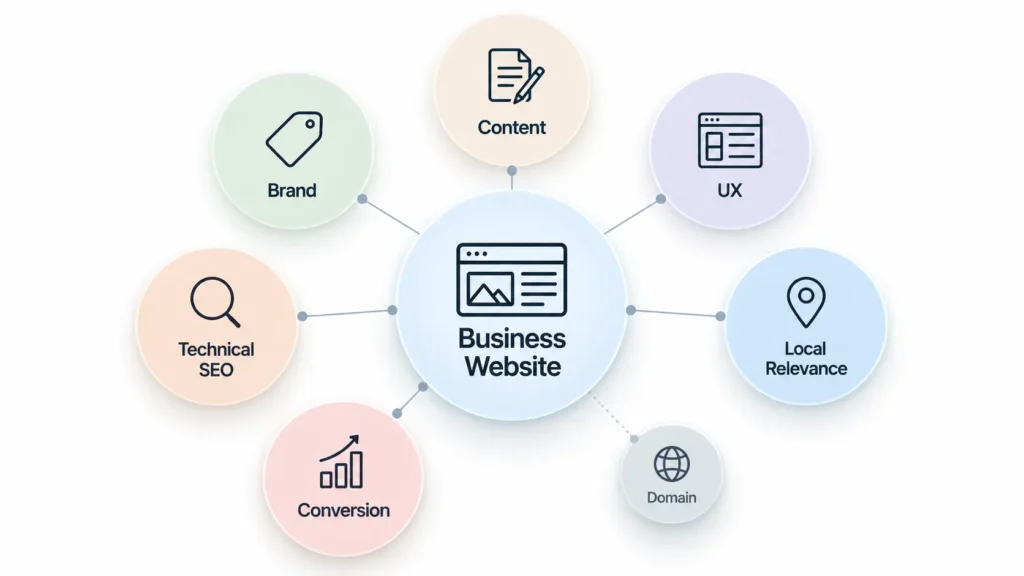
The website itself still needs:
- Useful content
- Clear service pages
- Good technical foundations
- Strong information architecture
- Relevant local information
- Good user experience
- Appropriate internal linking
- A clear conversion path
The extension cannot compensate for a weak website.
What About Local Businesses?
A local business sometimes assumes the domain should contain the city.
That can work.
But it is not mandatory.
If you run a business called Northstar Roofing and serve several nearby cities, a brand-based domain can give you more room to grow.
Your local relevance can be communicated through your website content, service-area information, business profile, structured data, and other signals.
Google’s international-site documentation makes clear that generic TLDs can be used for geographically targeted websites through other signals and URL structures.
So do not sacrifice a strong brand name simply because you think the city must appear in the domain.
A Five-Question Domain Test
Before registering the domain, ask:
1. Can customers remember it?
If they hear it once, can they recall it later?
2. Can customers spell it?
Avoid unnecessary complexity.
3. Does it fit the business?
Would it still make sense if the business grows?
4. Could someone confuse it with another business?
Check the corresponding domains and the broader brand landscape.
5. Are there trademark concerns?
Domain availability is not the same thing as legal clearance.
WIPO recommends considering trademark protection and potential conflicts when selecting a domain, while ICANN provides a UDRP framework for certain abusive trademark-related registrations.
A Practical Decision Matrix
| Situation | What I Would Consider First |
| Exact .com available | Usually take the clean .com |
| .com unavailable, .co clean | Investigate .co carefully |
| .com unavailable, .net fits industry | Consider .net |
| .com belongs to same-brand company | Be very cautious with alternatives |
| Available domain is long and awkward | Reconsider the brand/domain |
| Business expects international growth | Prefer a flexible generic option |
| Business is strongly technology-focused | .net may fit naturally |
| Business is local and may expand | Avoid unnecessary geographic restriction |
This is not a ranking of extensions.
It is a way to organize the decision.
Should You Buy Multiple Extensions?
If the brand matters and the relevant domains are reasonably priced, owning multiple extensions can be useful.
But keep one primary domain.
For example:
Primary website: brand.com
Redirect: brand.co
Redirect: brand.net
The goal is brand protection and convenience, not running three versions of the same website.
The Domain Should Survive the Business
This is the test I would use most often.
Imagine your business three years from now.
Will the domain still make sense?
If you currently provide one service but plan to expand, be careful about overly narrow domains.
If you currently serve one city but expect to expand, be careful about putting the city permanently into the brand.
If the business may eventually serve different customer groups, avoid a domain that locks you into one narrow description.
A domain is cheap compared with a rebrand.
But changing it later can still create unnecessary work.
There is no universal winner between .com, .co, and .net.
For many small businesses, I would still start by checking the .com.
If the exact .com is unavailable, a clean .co can be a reasonable alternative.
And .net can be a strong choice when it naturally fits the business, especially in technology and networking contexts.
But the most important decision is not the extension.
It is whether the complete domain is:
clear, memorable, brandable, flexible, and safe to use.
Choose that first.
Then choose the extension that supports it.