A customer visits your store, looks at a product, and leaves.
Another customer adds that same product to their cart, gets partway through the buying process, and leaves too.
Both customers disappeared. But they did not show the same level of intent.
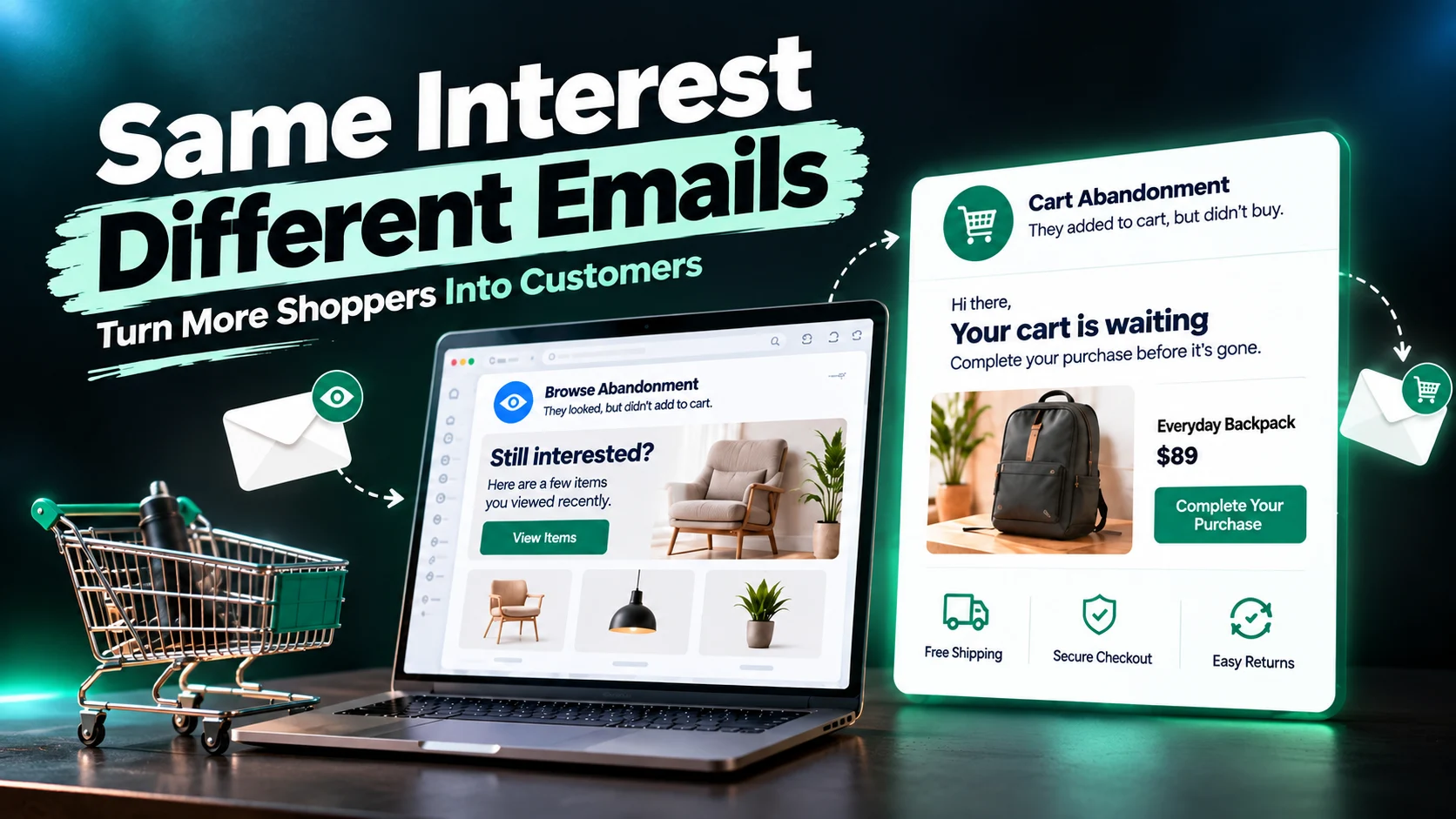
That difference is easy to overlook, and it is one of the reasons ecommerce email automation can become confusing. A browse abandonment email and a cart abandonment email may both bring someone back to a product, but they are responding to two different moments in the customer journey.
The better strategy is not to choose one and ignore the other. It is to understand what the customer’s behavior is telling you and make the email match that behavior.
The Key Difference Comes Down to Intent
Browse abandonment happens when someone views a product but leaves without adding it to their cart. In a typical browse abandonment flow, the customer has shown interest by viewing a product, but has not taken the stronger step of adding it to a cart. Klaviyo describes browse abandonment as a flow triggered by a viewed product event and specifically notes that viewing a product does not indicate the same level of interest as adding an item to a cart.
Cart abandonment happens later. The shopper has already added something to their cart, which means they have moved beyond simple product exploration.
That distinction changes the job of the email.
A browse abandonment email usually needs to recreate interest and continue the conversation.
A cart abandonment email usually needs to remove friction and make it easy to finish the purchase.
Browse Abandonment Is About Interest That Has Not Become a Decision
Imagine someone visits a skincare store and spends several minutes looking at a moisturizer. They read the product description, look through the photos, perhaps check the ingredients, and then leave.
They have shown interest, but you do not necessarily know why they left.
They may still be comparing products. They may be researching ingredients. They may not be ready to buy. They may have been interrupted. Or they may simply have decided that the product was not right for them.
That uncertainty should influence the tone of your email.
Klaviyo recommends treating browse abandonment as a lighter touchpoint than abandoned cart messaging because the shopper has shown a lower level of purchase intent.
So a browse email does not necessarily need to say, “You forgot something.”
The customer did not forget anything.
They were browsing.
A better message might bring the product back into view, remind them of its main value, provide useful context, or help them continue evaluating it.
Cart Abandonment Happens Closer to the Purchase
Now imagine a different customer.
They choose the moisturizer, add it to their cart, and start moving toward checkout. Then something interrupts them. Maybe they want to check the delivery cost. Maybe they need to find their card. Maybe they are comparing one final alternative.
This person has demonstrated a stronger buying signal.
An abandoned cart flow is specifically designed for people who added products to their cart but did not complete the purchase.
That means the message can be more direct.
You can remind them what they selected, make the return path obvious, answer common purchase concerns, and bring them back to the cart.
The customer does not need another introduction to the product. They have already chosen it.
Here Is the Strategic Difference
| Browse Abandonment | Cart Abandonment | |
| Customer action | Viewed a product | Added a product to cart |
| Purchase intent | Interest or consideration | Stronger purchase intent |
| Main challenge | Customer may still be deciding | Customer may be facing friction |
| Email role | Re-engage and educate | Remind and recover |
| Product focus | Viewed product | Cart contents |
| Tone | Lighter and less direct | More direct and action-oriented |
| Main CTA | View product | Return to cart or complete purchase |
| Discount | Usually not the first move | May be considered when justified |
| Main goal | Continue consideration | Help complete the purchase |
The table is useful, but there is a deeper point behind it.
Do not treat customer behavior as one generic form of abandonment.
The further someone moves through the buying journey, the more specific your communication can become.
What Should a Browse Abandonment Email Say?
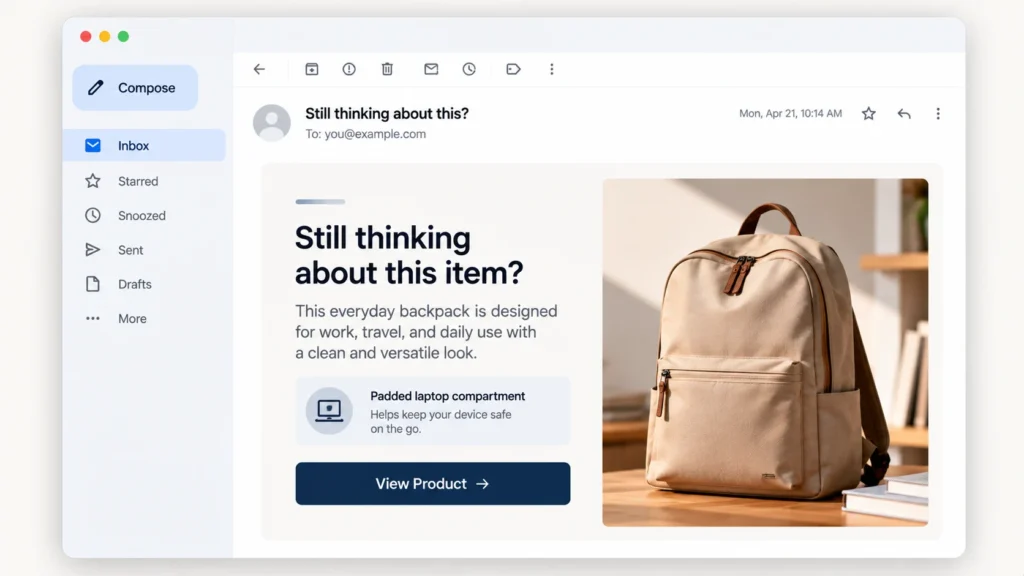
A browse abandonment email should help the customer continue evaluating the product.
Depending on your business, that could mean:
- Showing the product they viewed
- Reinforcing one or two useful benefits
- Providing helpful product information
- Showing related products
- Highlighting customer reviews
- Answering a common question
- Giving the customer a simple path back to the product page
The message should feel like a helpful continuation of the shopping experience rather than a demand to purchase.
For example, a clothing store could remind someone about a jacket they viewed and show how it looks in different settings. A furniture store might highlight dimensions, materials, or matching pieces. A specialist equipment store might explain compatibility or use cases.
The content should reflect the reason someone might still be considering the product.
What Should a Cart Abandonment Email Say?
The cart abandonment email can be much more focused because the customer has already made a stronger commitment.
The email might include:
- The products left in the cart
- Product images
- Price
- A direct link back to the cart
- Shipping or delivery information
- Return information
- A reminder of a relevant benefit
- A helpful answer to a common purchase concern
The objective is not to restart the entire sales conversation.
It is to make returning to the purchase easy.
Klaviyo’s current abandoned cart guidance also supports customizing flows with multiple messages and branching based on factors such as cart value, while recommending that stores avoid duplicate default and third-party abandoned cart messages.
That matters because sending several different systems after the same customer can create an unpleasant experience.
Timing Should Reflect the Customer’s Intent
Timing is not simply about sending an email as quickly as possible.
A browse abandonment email can afford to feel less urgent because the shopper may still be researching.
A cart abandonment message usually deserves a faster response because the customer has already demonstrated stronger purchase intent.
The exact timing should depend on your product, buying cycle, customer expectations, and existing automation.
For example, a low-cost consumer product may have a shorter decision window than an expensive piece of equipment that requires research.
The important principle is to avoid treating every product category as if customers make decisions at the same speed.
Klaviyo’s browse abandonment documentation recommends adding a time delay of at least one hour before the browse abandonment message, while its flow guidance allows additional delays and conditional splits depending on the strategy.
Use platform recommendations as a starting point, then consider what makes sense for your customer journey.
Do Not Automatically Discount Everything
One of the easiest mistakes in abandonment email marketing is assuming that every abandoned session needs a discount.
That can train customers to wait.
It can also hide the actual problem.
If someone abandoned because they were uncertain about shipping, a discount does not answer the question.
If someone abandoned because they did not understand the product, a discount does not provide clarity.
If someone abandoned because checkout felt complicated, a discount does not fix the checkout experience.
Before offering an incentive, ask what probably caused the abandonment.
Sometimes the right message is simply:
“Still considering this?”
Other times, the better message is:
“Here is the information you were looking for.”
And sometimes the right answer is an incentive. The strategy should follow the situation.
Your Email Should Match the Customer’s Previous Action
This is where segmentation becomes important.
A customer who viewed one product should not automatically receive the same message as someone who added three high-value products to their cart.
You can make the experience more relevant by considering:
- Product category
- Product price
- Number of products
- Previous purchases
- Customer status
- New versus returning customer
- Geographic market
- Product availability
- Whether the customer has already received an abandonment message
Klaviyo’s flow system supports event-triggered automation and conditions based on customer behavior, including Viewed Product and Started Checkout events.
The broader lesson is simple: the more useful your behavioral data is, the less generic your email needs to be.
Do Not Let Different Abandonment Flows Fight Each Other
This is an important technical and strategic issue.
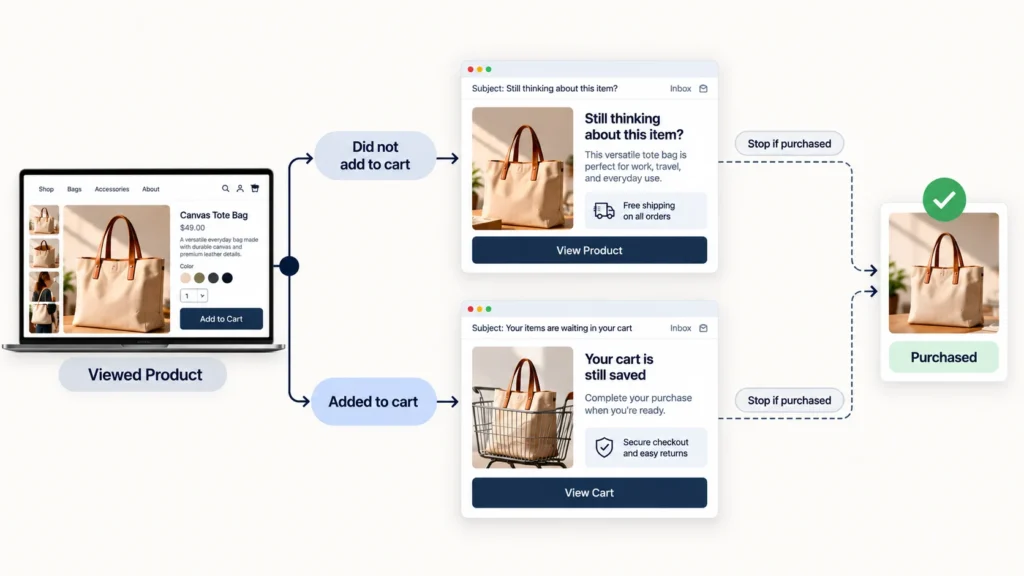
Suppose someone views a product, adds it to their cart, and then leaves.
If your browse abandonment flow and cart abandonment flow are both running without proper conditions, the same person could receive messages from both.
That creates confusion.
A well-structured automation should recognize that the customer has moved to a later stage of the journey and prevent the earlier message from competing with the more relevant one.
For example, a browse abandonment flow can exclude people who have since added the product to their cart. Similarly, both flows should stop or exclude customers after a completed purchase.
This is one reason automation design deserves as much attention as email design.
The Product Page Still Matters
It is tempting to treat abandonment emails as the solution to a conversion problem.
But sometimes the email is only revealing a problem that exists on the website.
If many people repeatedly view a product and leave, look at the product page.
Are the product details clear?
Are the images useful?
Are shipping costs explained?
Are reviews visible?
Are product variations confusing?
Is the return policy easy to find?
If many customers add the product to their cart but do not complete checkout, examine the checkout experience too.
Email automation can recover some lost opportunities, but it should not become a substitute for fixing the customer journey.
Browse and Cart Emails Work Better as a System
A useful ecommerce automation strategy does not treat browse abandonment and cart abandonment as competing email types.
They are different stages of the same customer journey.
A simplified flow might look like this:
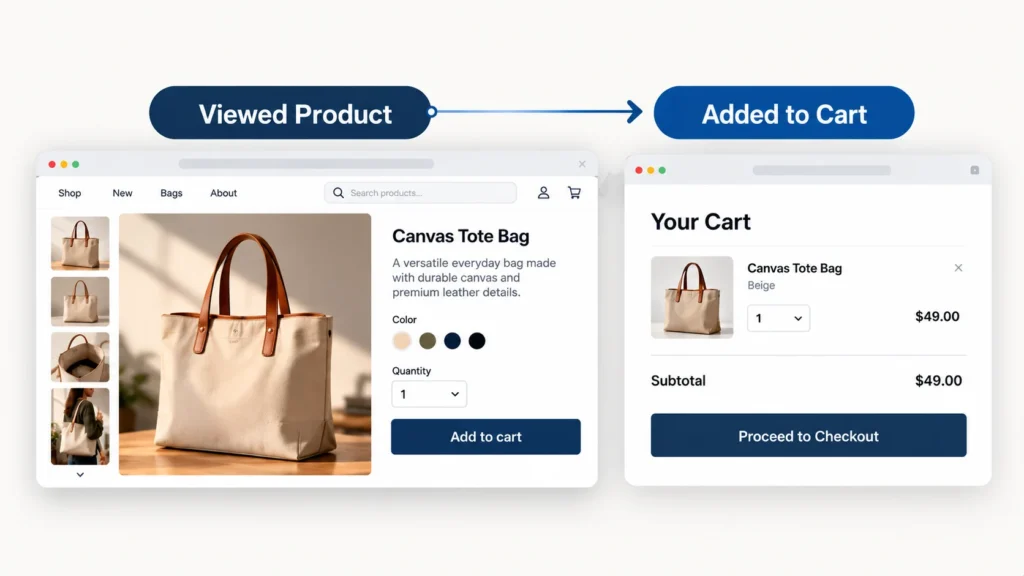
Viewed Product → Consideration → Added to Cart → Checkout → Purchase
Each stage gives you different information about the customer’s intent.
The communication should evolve with it.
Browse abandonment can help someone continue considering.
Cart abandonment can help someone complete.
Post-purchase communication can then help with onboarding, product use, reviews, repeat purchases, or customer retention.
That is much more strategic than creating a single “abandoned cart email” and expecting it to solve every form of lost intent.
A Practical Way to Decide What to Build First
If you are starting from scratch, begin by understanding your customer journey rather than immediately creating a large collection of automations.
If your store gets significant product-page traffic but relatively few add-to-cart actions, browse abandonment may deserve attention because there is a large consideration stage to understand.
If customers regularly add products to carts but fail to complete purchases, cart abandonment is more directly connected to that behavior.
If both happen at meaningful levels, both flows may make sense, but they should have different triggers, messaging, timing, and suppression rules.
The goal is not to have more automations.
The goal is to make each automation respond intelligently to a real customer action.
What Your Abandonment Emails Should Really Be Doing
Browse abandonment and cart abandonment emails are different because the customers behind them are different.
A product view tells you, “I am interested enough to look.”
A cart action tells you, “I am interested enough to consider buying this.”
Those are not the same signal, so they should not receive the same message.
If you build your automations around that distinction, your email strategy becomes more relevant and easier to manage. Browse emails can support consideration without creating unnecessary pressure, while cart emails can focus on removing the final obstacles between intent and purchase.
And if the emails still need heavy discounts, repeated reminders, or increasingly aggressive messaging to work, that is worth investigating. The bigger opportunity may be somewhere earlier in the customer journey.