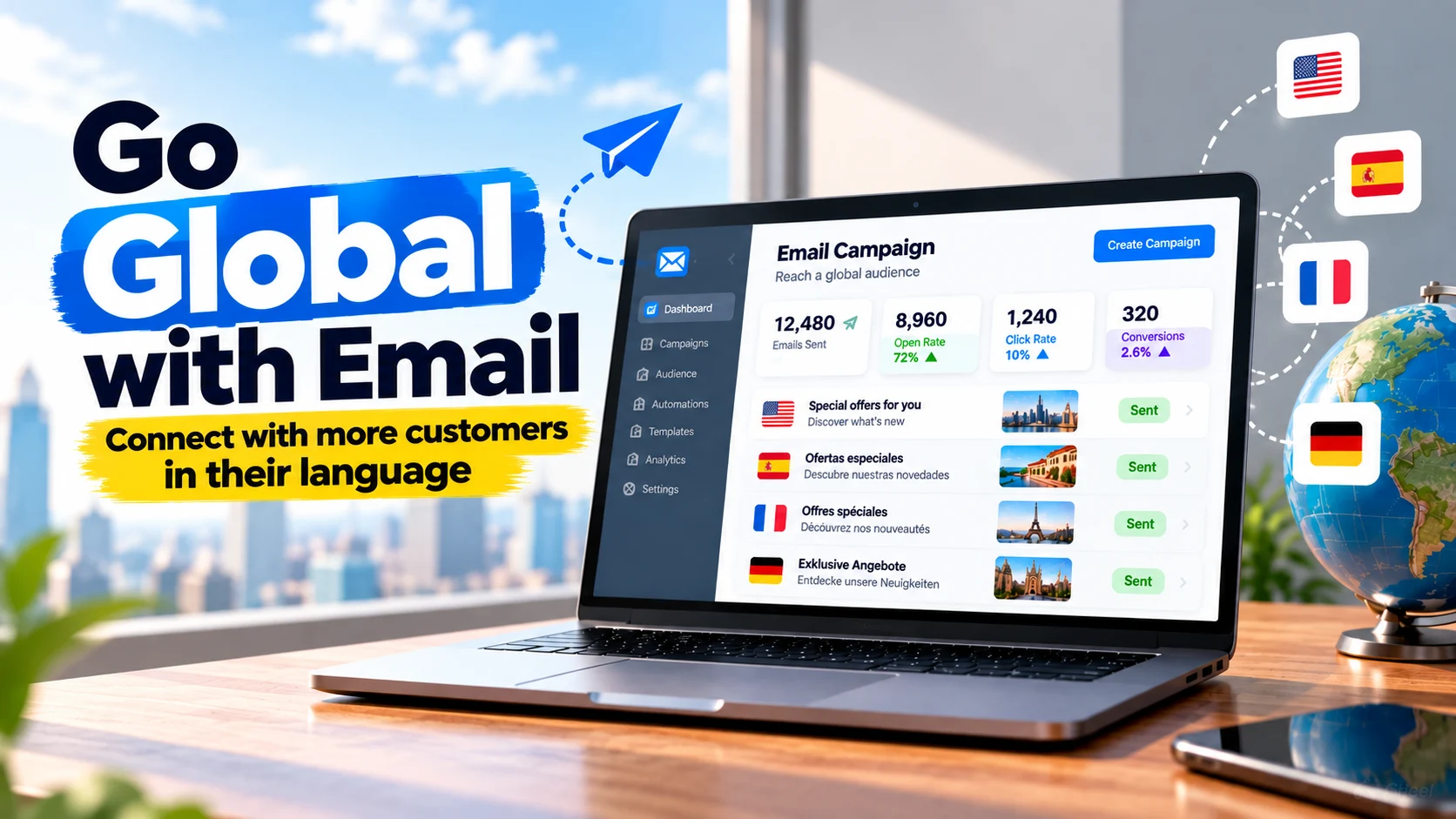
A multilingual email campaign can look simple from the outside. Write the email, translate it, send it to another audience, and move on.
The problem is that a good multilingual campaign is rarely just a translated version of an English campaign. The message has to make sense in another language, the offer has to remain clear, the timing may need to change, and the customer should feel that the email was created for them rather than passed through a translation tool.
If your business serves customers in more than one language, the real question is not simply, “How do I translate my emails?” It is, “How do I make the same customer journey feel natural for people who speak different languages?”
That shift in thinking is what separates a multilingual email campaign from a translated email.
Start With the Customer, Not the Translation
Before creating different language versions, decide who each version is actually for.
Language is only one part of the customer context. Depending on your business, you may also need to consider location, currency, product availability, local terminology, cultural expectations, time zone, and the action you want the recipient to take.
For example, imagine an online service company that communicates with customers in English, Spanish, and French. The core offer may remain the same, but the way you explain the offer, the examples you use, and even the preferred call to action may need adjustment.
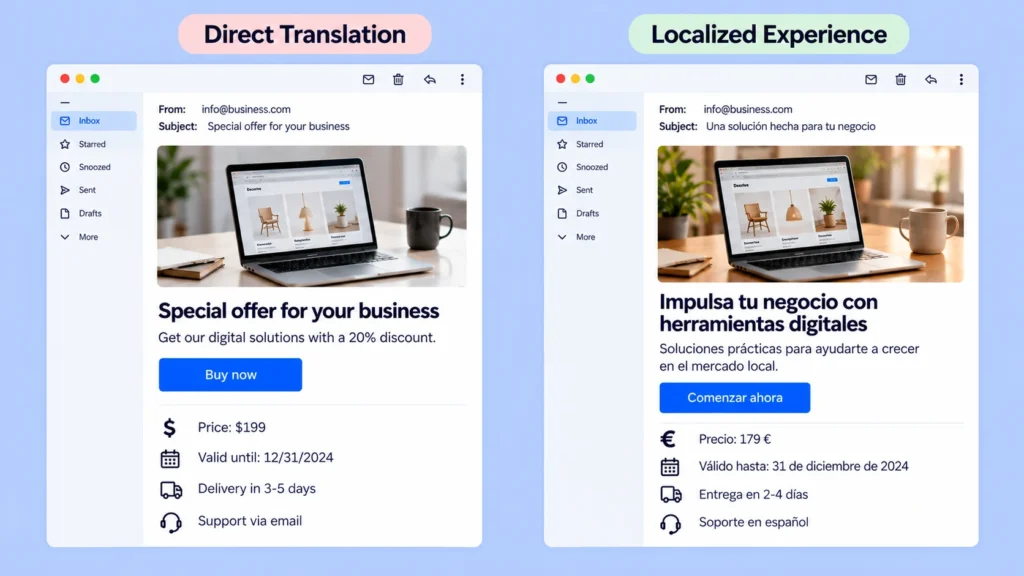
This is why simply translating every sentence word for word can produce an email that is technically understandable but commercially awkward.
A better starting point is to define the customer journey first, then adapt the communication for each language audience.
Know Which Language Your Subscriber Actually Wants
One of the most important decisions is how you determine a subscriber’s preferred language.
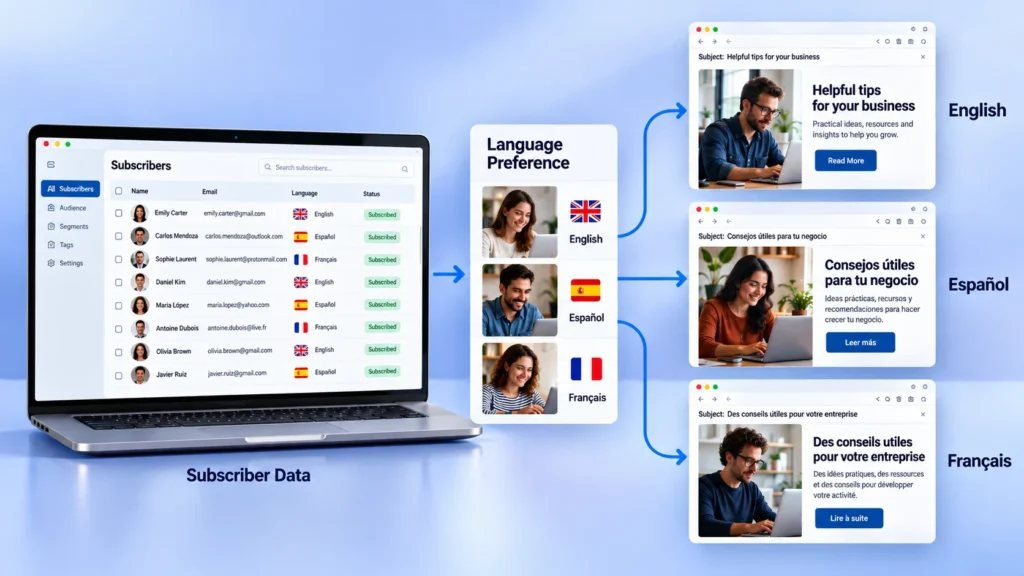
You might collect it directly through a signup form. You might use customer profile data, previous interactions, location, or detected browser language. Some email platforms can use language information to segment subscribers and deliver different versions of an email.
For example, Mailchimp’s guide to managing international subscribers explains that language and location data can be used to segment contacts and create multilingual email experiences.
The important point is that language preference should be treated as customer data, not as a guess.
If someone lives in France, that does not automatically mean French is the language they want to receive your emails in. Likewise, someone browsing from Canada may prefer English or French. When possible, give subscribers a clear way to choose.
A simple signup question such as:
Preferred language: English / Français / Español
can sometimes be more useful than trying to infer everything automatically.
Build One Campaign Strategy, Then Adapt the Language Versions
A multilingual campaign does not mean creating completely different marketing strategies for every language.
Your underlying campaign can remain consistent:
Problem → Value → Explanation → Offer → Action
What changes is how that journey is expressed.
For example:
English:
“Your website is ready for more enquiries. Let’s make it easier for visitors to take the next step.”
The Spanish and French versions should communicate the same business idea, but they should be written naturally for those audiences rather than translated mechanically.
This distinction matters because direct translation can preserve words while losing intent.
Your translator or localization process should therefore review:
- Subject line
- Preheader
- Main headline
- Body copy
- Buttons
- Product or service terminology
- Dates and numbers
- Currency
- Footer information
- Unsubscribe and preference language
- Landing-page copy connected to the email
The email and the page it leads to should feel like part of the same experience.
Localization Is More Than Changing the Words
Translation answers the question, “What does this sentence mean in another language?”
Localization asks a broader question: “How should this message be presented to this audience?”
That difference becomes important when an email includes:
- Currency
- Dates
- Measurements
- Names and titles
- Local terminology
- Cultural references
- Offers
- Delivery information
- Business hours
- Seasonal campaigns
A promotion that works perfectly in one market may need a different example or explanation in another.
You do not necessarily need to redesign the entire campaign for every market. But you should review the elements that could create confusion or make the message feel imported.
Keep the Email Focused on One Main Action
Multilingual emails can become complicated very quickly because every additional language increases the amount of content you have to manage.
That makes simplicity even more important.
If the campaign is asking the reader to book a consultation, make that action obvious. If the goal is to browse a collection, make the product path clear. If the purpose is to educate, give the reader one useful next step.
Avoid creating an email where every language appears one after another unless there is a genuine reason to do so.
For most campaigns, showing English, Spanish, French, German, and Italian in one long email is harder to read and can make the message feel unnecessarily heavy.
A better approach is usually to send the appropriate language version to the appropriate audience.
Platforms such as Mailchimp’s multilingual email documentation support approaches such as language-based content, conditional content, and separate language segments.
Decide Between Separate Emails and Conditional Content
There is no single correct technical setup.
You can create separate campaigns for each language, or you can build one campaign that dynamically displays different content based on subscriber information.
The right choice depends on your audience size, automation setup, number of languages, and how much control you need.
| Approach | Useful when | Main consideration |
| Separate campaign per language | You want maximum control | More campaigns to manage |
| Language-based segments | Your audience data is organized | Requires reliable language data |
| Conditional content | The campaign structure is mostly shared | Requires careful setup and testing |
| Translation link | You need a simple fallback | Less control over the translated experience |
For example, Mailchimp documents the use of conditional content to display different email content based on a contact’s language information.
The important decision is not which feature sounds most advanced. It is which setup gives you enough control without creating unnecessary operational complexity.
Write for the Language, Not Against It
A common mistake is writing the original campaign in complicated English and expecting the translation process to solve the problem.
That makes every language version harder.
Start with clear writing.
Use shorter sentences where appropriate. Avoid unnecessary idioms. Avoid jokes that depend entirely on English wordplay. Be careful with expressions that may not have a natural equivalent in another language.
For example, a phrase like “Let’s get the ball rolling” may sound perfectly normal in English but may not carry the same meaning when translated literally.
Clear source writing gives the translator more room to produce natural copy.
The goal is not to make every language version identical word for word. The goal is to preserve the meaning, intent, and customer action.
Do Not Forget the Subject Line
The subject line deserves separate attention.
It is often one of the most compressed parts of an email, which means a literal translation may not communicate the same idea with the same impact.
Instead of translating the English subject line word for word, ask:
What is this subject line trying to make the reader understand or feel?
Then recreate that idea naturally in the target language.
The same applies to the preheader and call-to-action button.
Your campaign should have consistent intent across languages, but the wording does not need to be mechanically identical.
Test Every Language Version Before Sending
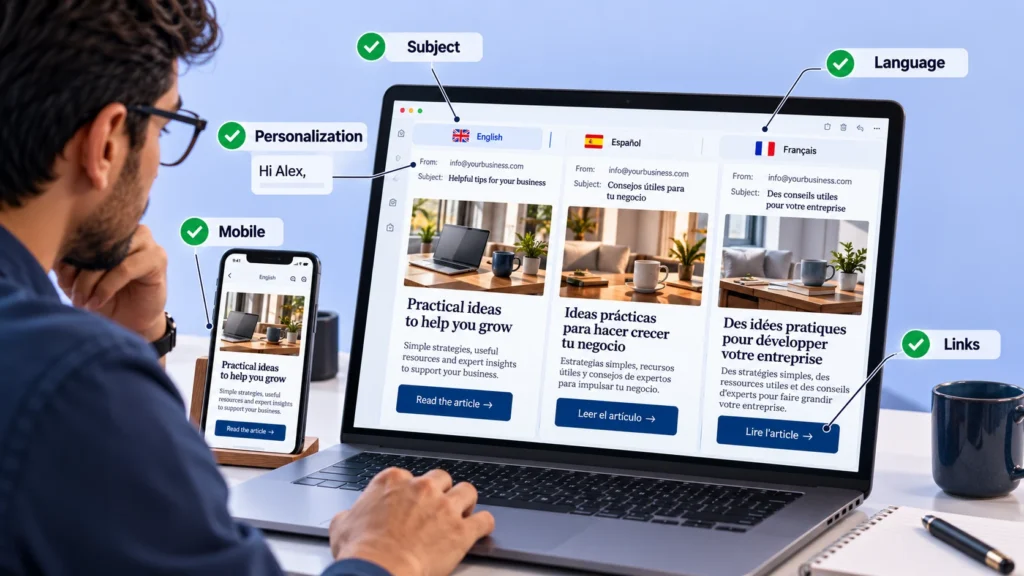
A multilingual campaign creates more opportunities for errors.
One language may have longer words. Another may require more space around a button. A translated sentence may change the height of a content block. A currency format may be wrong. A link may point to the wrong regional page.
Testing should therefore happen at the language level, not just at the campaign level.
Review:
- Desktop rendering
- Mobile rendering
- Subject line
- Preheader
- Links
- Buttons
- Personalization
- Currency
- Dates
- Images
- Footer
- Unsubscribe link
- Landing-page language
- Fallback language
- Personalization fields
If your email platform uses dynamic or conditional content, test different language profiles before the campaign reaches the full audience. Mailchimp specifically recommends previewing and testing merge tags before sending.
Think About Accessibility Too
Language selection is also part of the user experience.
If an email or linked page contains multiple languages, the language of the content should be identifiable to assistive technologies. W3C guidance explains that the language of content should be programmatically identifiable, including when a passage changes to another language.
For a multilingual customer journey, that means accessibility should not be treated as something separate from localization.
Clear language, readable structure, descriptive links, appropriate alternative text, and properly identified language all contribute to a more usable experience.
Privacy and Marketing Rules Still Apply
Changing the language of an email does not change the responsibilities that come with sending marketing communications.
If you serve customers in regions governed by privacy or electronic marketing rules, review the requirements that apply to your audience and campaign.
For example, the European Commission notes that promotional emails involve personal-data processing under the GDPR and that direct marketing must also comply with applicable ePrivacy rules.
Consent and preference information should also be communicated clearly. The European Commission explains that valid consent must be freely given, specific, informed, and unambiguous, with information presented clearly enough for people to understand what they are agreeing to.
For a multilingual campaign, that means your preference and consent experience should make sense to the people using it, rather than leaving important information only in another language.
Measure Language Versions Separately
Once the campaign is running, do not look only at the total campaign result.
Compare meaningful differences between language audiences where the data is large enough to support a useful comparison.
Depending on the campaign, that might include:
- Delivery
- Click-through rate
- Conversion rate
- Unsubscribe rate
- Revenue
- Booking activity
- Landing-page engagement
The purpose is not to declare one language version “better” based on a single metric.
Instead, look for questions worth investigating.
If one audience clicks frequently but converts less often, perhaps the landing page is not localized. If one language version generates more unsubscribes, the frequency, offer, or messaging may need review.
The email is only one part of the customer journey.
What a Good Multilingual Campaign Actually Does
A good multilingual email campaign should make the customer feel that the business understands how they communicate, not simply that the business owns a translation tool.
That starts with reliable language information, continues through thoughtful localization, and ends with a consistent experience from email to landing page. The technical setup matters, but the strategy behind it matters more.
You do not need to create completely different marketing ideas for every language. You need a clear campaign strategy and enough flexibility to express that strategy naturally for each audience.
The Practical Takeaway
If your business is preparing its first multilingual email campaign, start smaller than you think. Choose the languages that genuinely matter to your current customers, collect reliable language preferences, create a clear campaign structure, and make sure each version feels naturally written rather than mechanically translated.
Then test the entire customer journey, not just the email itself. A beautifully translated email can still create a poor experience if the landing page, booking process, product information, or follow-up emails remain in another language.
The strongest multilingual campaign is not the one with the most languages. It is the one where each customer receives a clear, relevant message and knows exactly what to do next.