

If you run a local service business, it is easy to fall into a simple SEO equation:
More articles = more keywords = more rankings.
The problem is that local search does not work that neatly.
Publishing useful content can absolutely support search visibility. But adding pages simply because you want more keywords can leave you with a larger website without solving the problems that are actually limiting your visibility.
Google’s guidance emphasizes helpful, reliable, people-first content and warns against producing large amounts of content primarily to attract search traffic.
For a local service business, the better question is:
Does this new page make the business easier for the right customer to find, understand, trust, and contact?
Why Content Volume Can Become a Distraction
Suppose a local plumbing company has five important services.
Its service pages are thin. The contact process is confusing. The business information is incomplete. The website doesn’t clearly explain its service area.
But the owner decides the solution is to publish three blog posts every week.
That creates activity, but not necessarily progress.
The problem may not be a shortage of articles.
It may be a shortage of useful business information.
A good local SEO strategy should connect search visibility with the actual customer journey. Content should support that journey rather than operate separately from it.
Local Rankings Are Not Controlled by Blog Posts Alone
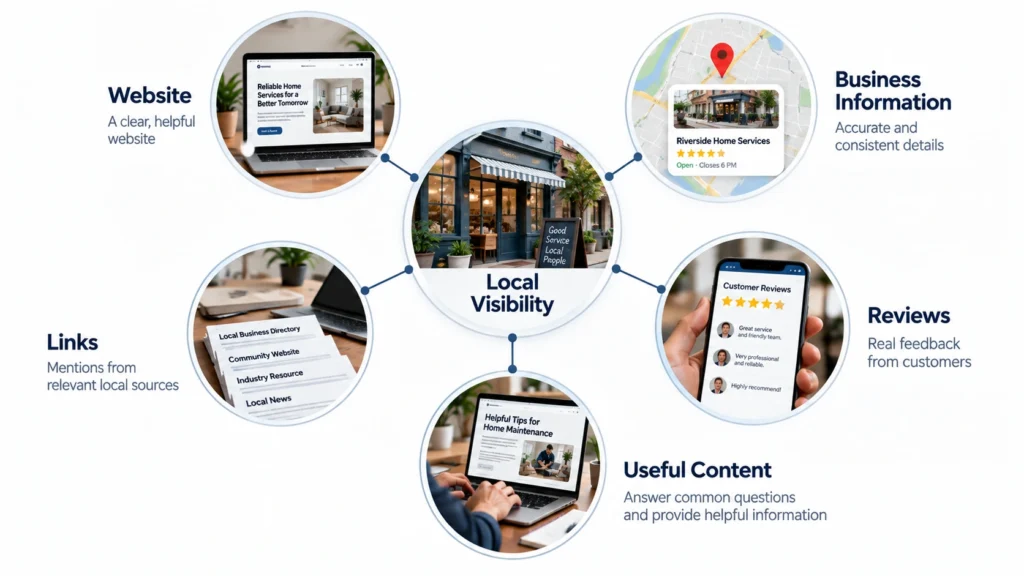
Google says local search results are mainly influenced by relevance, distance, and prominence.
That means a local business has several areas to manage.
Your content can help Google and customers understand your expertise and services. But your website structure, business information, reviews, links, and local relevance also matter.
This is why I would not recommend creating a content plan before looking at the whole website.
Fix the Commercial Pages Before Adding More Supporting Content
For most local service businesses, the most important pages are not blog posts.
They are the pages that explain what the business actually does.
Start with:
- Homepage
- Main service pages
- Relevant service-specific pages
- Genuine location or service-area pages
- About page
- Contact page
Then review each page from a customer’s perspective.
Can someone quickly answer:
- What service does this company provide?
- Is it relevant to my problem?
- Does it serve my area?
- Why should I consider it?
- What happens next?
- How do I contact them?
If those answers are difficult to find, publishing another article may not be the best next move.
Google’s SEO documentation recommends clear, descriptive titles and useful site structures that help users and search engines understand pages.
What Good Supporting Content Looks Like
Once the core pages are strong, supporting content becomes much more useful.
Consider a local electrician.
Instead of publishing generic posts about “electrical tips,” the business could answer questions that appear naturally around its services:
- When should you call an electrician for flickering lights?
- What happens during an electrical inspection?
- Can an old electrical panel be repaired?
- What should homeowners check before an electrical upgrade?
- How long does a typical electrical installation take?
These topics have a clear relationship with the business.
They can educate potential customers while creating natural pathways toward relevant services.
That is a much stronger role for content than simply filling a blog.
Don’t Turn Every Location Into a New Page
Local SEO also creates another common temptation: city-page multiplication.
A business serves ten nearby areas, so someone suggests creating ten almost identical pages.
Sometimes location pages are completely appropriate. But they need to provide genuine value.
If the only meaningful change is the city name, the page may not deserve to exist.
Google’s spam documentation specifically identifies doorway abuse as including substantially similar pages created for specific regions or cities that funnel users toward another page.
So instead of asking:
“Which cities can we create pages for?”
Ask:
“What useful local information can we provide for customers in this area?”
That produces a much healthier strategy.
A Content Audit Can Be More Valuable Than a New Content Calendar
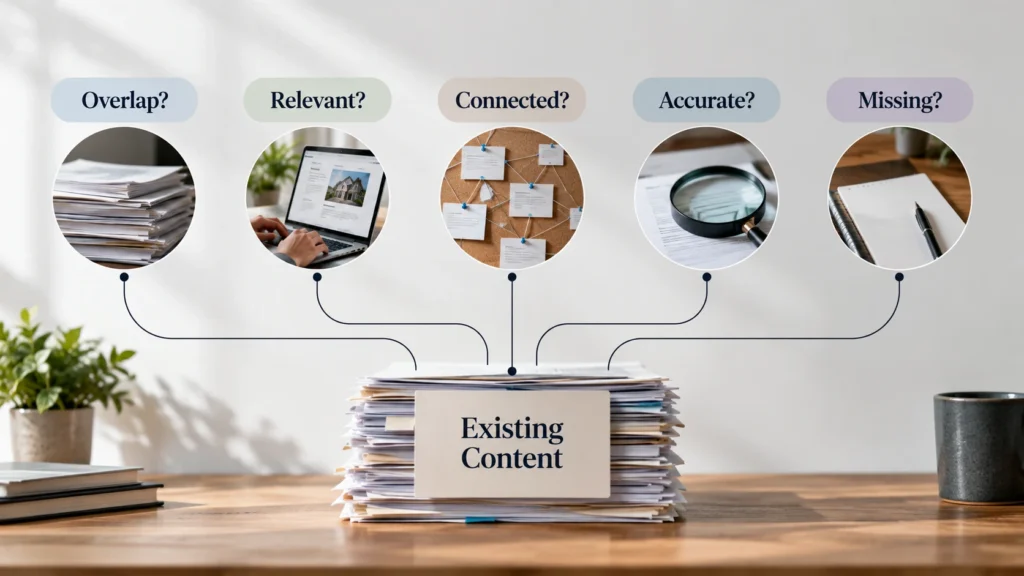
If the website already has dozens or hundreds of articles, stop publishing for a moment.
Review what exists.
Look for:
Overlap:
Are several pages answering essentially the same question?
Weak intent:
Does the article attract searches that have little connection to the business?
Missing connections:
Does the article naturally lead readers toward a relevant service?
Outdated information:
Is the content still accurate?
Missing topics:
Are customers asking questions that the website never answers?
Thin location pages:
Are there pages that exist mainly because of keyword targeting?
The answers can reveal that the next SEO improvement is not another article.
It may be consolidation, rewriting, restructuring, or strengthening an important service page.
A Simple Decision Framework
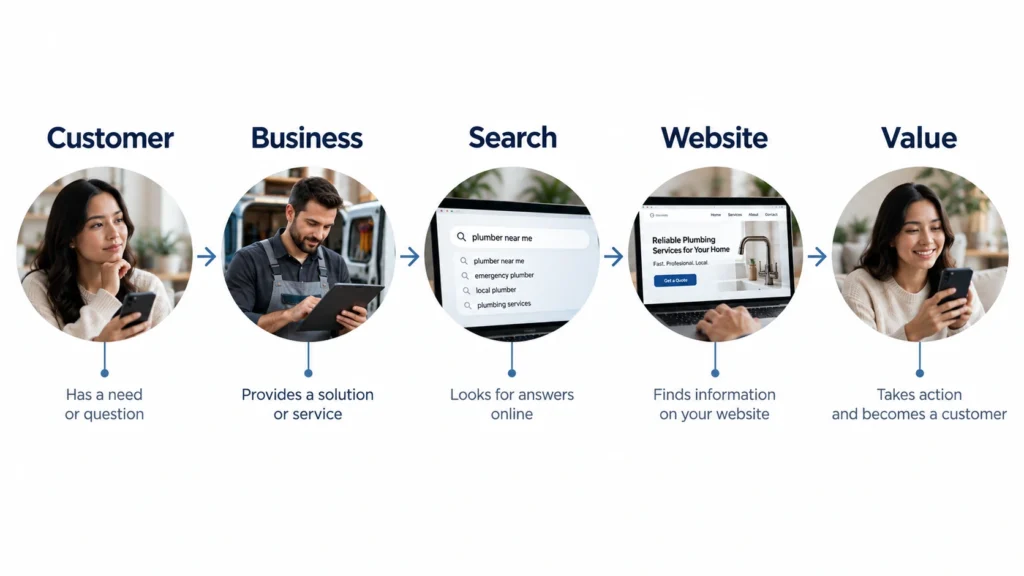
Before creating another SEO page, run it through five questions:
- Customer: Is this something the target customer actually wants to understand?
- Business: Is it connected to a real service, product, or expertise area?
- Search: Does it address a meaningful search intent?
- Website: Does it strengthen the existing site structure?
- Value: Would the page still be useful if Google sent it zero visitors?
If the last answer is no, rethink the page.
Google’s people-first guidance is built around a similar principle: content should be created primarily to help people rather than primarily to manipulate search visibility.
The Goal Is a Better Website, Not a Bigger Website
For a local service business, I would define content success differently.
Not:
“We published 30 articles this quarter.”
Instead:
“Our website answers more of the questions customers have before choosing us.”
That is a much more useful measurement.
A strong content ecosystem should help someone move from:
Search → Understanding → Trust → Service Evaluation → Contact
When a new page contributes to that journey, it has a clear purpose.
When it does not, publishing it simply because it contains another keyword may create more work without solving the underlying problem.
Final Thought
More SEO content can help when it is useful, relevant, original, and connected to the business.
But there is no automatic relationship between the number of pages you publish and better local rankings.
If your website already has enough content, the smarter move may be to improve what you have.
Strengthen the service pages. Clarify the local information. Remove unnecessary duplication. Answer real customer questions. Connect supporting articles to the parts of the website that matter.
Build a more useful website before trying to build a bigger one.