
Your ecommerce store may have a great website, good products, and a steady flow of visitors.
But if every email campaign still depends on someone remembering what to send, when to send it, and who should receive it, your email marketing is probably doing less work than it could.
The right email platform can change that.
But choosing one is not simply a matter of finding the tool with the most features.
For ecommerce, the important question is whether the platform can connect your customer data, products, orders, browsing behavior, segmentation, and automated journeys in a way your team can actually manage.
What Makes an Email Platform Good for Ecommerce?
A normal email newsletter tool can send an email to a list.
An ecommerce email platform should understand much more.
It should ideally help you work with events such as:
- A customer subscribing
- A product being viewed
- A cart being abandoned
- A checkout being started
- An order being completed
- A customer buying repeatedly
- A customer becoming inactive
That data allows email to become part of the customer journey rather than a separate marketing activity.
The difference is significant.
Instead of sending “20% off everything” to your entire list, you can communicate differently with someone who just subscribed, someone who bought last week, and someone who has not purchased in six months.
The Platforms Worth Comparing
For most ecommerce businesses, I would put six platforms on the initial shortlist:
Klaviyo, Omnisend, Mailchimp, Drip, ActiveCampaign, and Brevo.
But I would not rank them from one to six.
The better approach is to match each platform with the business problem it solves best.
Klaviyo: When Customer Data Is Central
Klaviyo is particularly strong when an ecommerce business wants to make customer data a major part of its marketing strategy.
Its current feature set emphasizes customer profiles, segmentation, automated flows, integrations, and cross-channel campaigns.
That gives a store room to build more sophisticated journeys.
For example, a clothing store could treat these customers differently:
- Someone who viewed running shoes
- Someone who purchased running shoes
- Someone who buys every three months
- Someone who has a high customer value
- Someone who has stopped engaging
That level of segmentation can become powerful when the store has enough customer data to justify it.
The downside is simple: sophisticated systems require more strategic work.
Best fit: Ecommerce businesses that are ready to invest seriously in customer segmentation and lifecycle automation.
Omnisend: When Ecommerce Is the Main Focus
Omnisend is designed specifically around ecommerce marketing and combines email with SMS, push notifications, segmentation, forms, reporting, and automated workflows.
Its ecommerce workflows include common journeys such as welcome, abandoned cart, browse recovery, and post-purchase.
That makes it particularly practical for online stores that want their email platform to understand ecommerce behavior from the start.
Best fit: Stores looking for ecommerce-first automation and practical omnichannel capabilities.
Mailchimp: When You Want a Broader Marketing Platform
Mailchimp has a broader marketing footprint and currently supports ecommerce journeys, abandoned-cart automation, behavioral targeting, post-purchase communication, and ecommerce reporting.
That can be useful if email is only one part of your wider marketing operation.
The important consideration is whether your store needs advanced ecommerce lifecycle marketing or simply wants a reliable platform that covers email and several related marketing tasks.
Best fit: Small and growing businesses that want ecommerce email alongside broader marketing capabilities.
Drip: When Ecommerce Automation Is the Priority
Drip is specifically positioned around ecommerce marketing automation.
It supports behavior-based messaging and ecommerce integrations, making it useful when you want customer actions to drive communication.
For example:
A customer browses a product.
The system records that behavior.
The customer receives a relevant message.
Later, if they purchase, the next communication can change.
That is much more useful than sending the same newsletter to everyone.
Best fit: Ecommerce stores that want behavior-driven automation without building an unnecessarily broad marketing stack.
ActiveCampaign: When Journeys Become More Complex
ActiveCampaign is worth considering when ecommerce automation needs to connect with more advanced customer journeys.
Its ecommerce tools support product-based targeting, abandoned-cart automation, cross-selling, and multi-step workflows.
That can be valuable for businesses with more complicated lifecycle requirements.
But complexity should be earned.
If your store only needs a welcome sequence and abandoned-cart recovery, you probably do not need an elaborate automation architecture.
Best fit: Ecommerce businesses with more sophisticated automation or broader customer lifecycle requirements.
Brevo: When Communication Needs Go Beyond Email
Brevo supports email automation and ecommerce workflows such as abandoned-cart recovery.
It may be worth considering when the business wants email to sit alongside broader customer communication rather than building an ecommerce-only marketing environment.
Best fit: Businesses looking for practical email automation within a broader communication platform.
The Features I Would Actually Compare
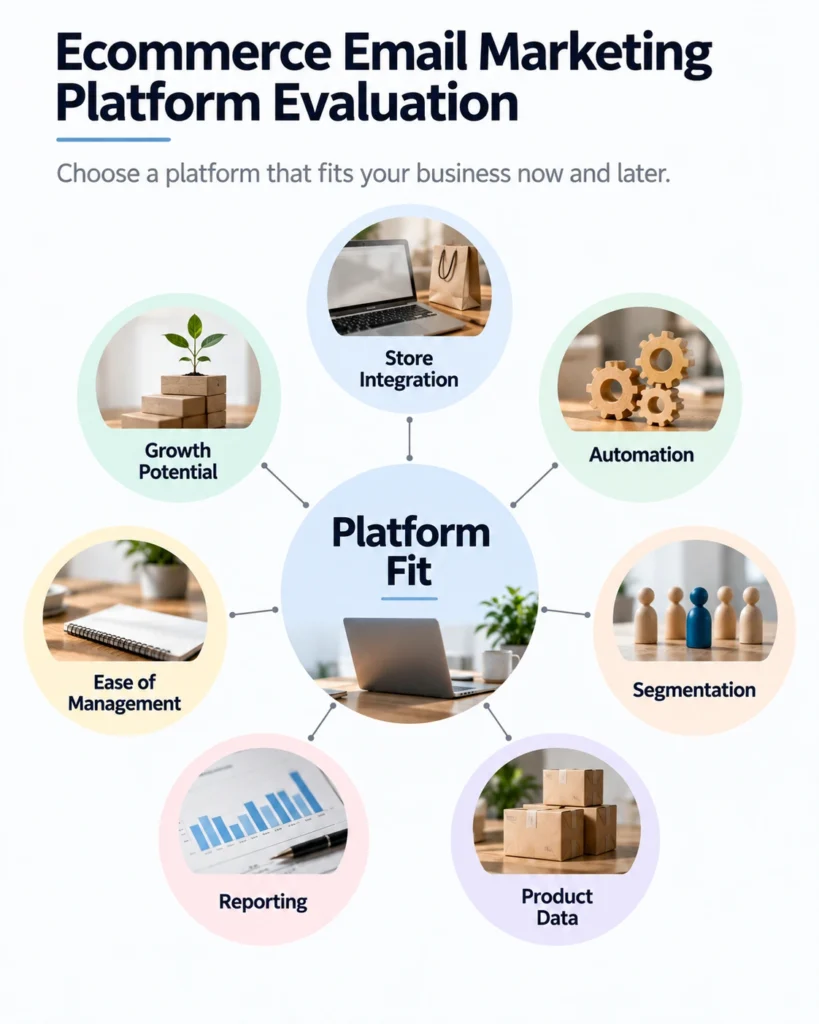
Instead of comparing every feature, I would focus on seven areas.
1. Store integration
Can the platform reliably receive the customer and order information your store needs?
2. Automation
Can you build the customer journeys you actually need?
3. Segmentation
Can you create useful audiences based on behavior, purchase history, engagement, or customer value?
4. Product data
Can emails use relevant product and purchase information?
5. Reporting
Can you understand whether campaigns and automations are contributing to business outcomes?
6. Ease of management
Can your team actually operate the system without constantly needing technical assistance?
7. Growth potential
Can the platform handle your next stage of growth without forcing another migration?
That last point matters more than it first appears.
Migrating email platforms can involve lists, templates, automations, integrations, forms, tracking, and historical data.
It is not something you want to repeat every few months.
Build These Automations Before You Build Dozens of Campaigns
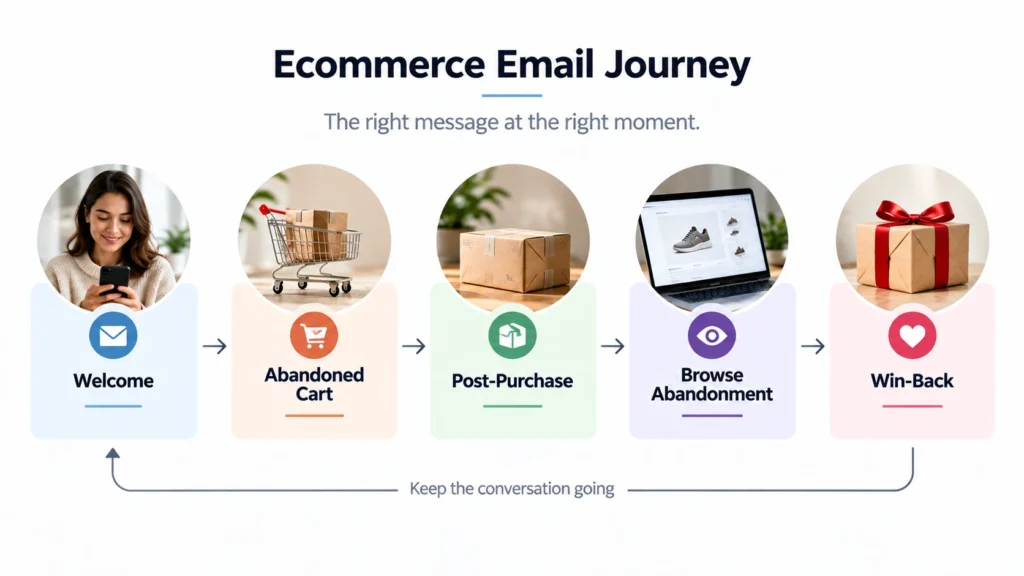
If you are starting from scratch, I would not build 30 automations.
Start with the journeys that matter most.
Welcome
Introduce the brand, set expectations, and help the subscriber take the next step.
Abandoned cart
Remind shoppers about products they left behind and make it easy to return to checkout.
Post-purchase
Help customers understand what happens next and create an opportunity for continued engagement.
Browse abandonment
Where appropriate, reconnect with visitors who showed meaningful product interest without purchasing.
Win-back
Reconnect with customers who have become inactive.
Once these foundations are working, you can add more sophisticated flows.
Do Not Let Discounts Become Your Entire Email Strategy
This is another area worth thinking about.
If every email says “20% off,” your audience can quickly learn to wait for the next discount.
Email marketing should also help with:
- Product education
- Customer onboarding
- Recommendations
- Reviews
- Cross-selling
- Replenishment
- Loyalty
- New product launches
- Brand storytelling
Automation is not only a sales mechanism.
It is a way to make the customer experience more consistent.
What About Shopify and WooCommerce?
Your ecommerce platform should be part of the decision.
A store built on Shopify may have different integration requirements from a WooCommerce store.
The important thing is not simply whether a platform says it “integrates.”
You should verify what data is actually passed between the systems and which ecommerce events can trigger your workflows.
For example, ActiveCampaign’s current abandoned-cart documentation supports ecommerce integrations including Shopify and WooCommerce, while Drip highlights Shopify and WooCommerce as ecommerce integrations for its automation system.
That level of integration is much more important than a generic “Shopify compatible” badge.
The Right Tool Depends on the Store
There is no universal winner.
If your store is heavily dependent on behavioral data and sophisticated segmentation, Klaviyo deserves serious consideration.
If you want an ecommerce-focused environment with email, SMS, and push automation, compare Omnisend.
If you want broader marketing capabilities, Mailchimp may fit better.
If ecommerce automation is the central requirement, Drip is worth evaluating.
If customer journeys are becoming complex, ActiveCampaign deserves a closer look.
If you want practical automation alongside broader communication capabilities, Brevo may be worth considering.
The Bottom Line
The biggest mistake is choosing an email platform based on popularity.
Choose based on fit.
Start with your store.
Map the customer journey.
Identify the automations that matter.
Then compare platforms against those requirements.
A smaller platform that your team understands and actually uses can be far more valuable than a powerful system that becomes too complicated to maintain.
The best email marketing tool is not the one that gives you everything.
It is the one that gives your ecommerce business what it actually needs.