

A homeowner can see the problem, but they usually cannot see the full service behind it.
They see water on the basement floor. A waterproofing professional sees drainage, grading, cracks, hydrostatic pressure, gutters, downspouts, and possible entry points.
They hear an unusual HVAC noise. The technician is thinking about several components and possible causes.
They notice a roof leak. The contractor may need to investigate areas that are nowhere near the spot where the water appeared inside the house.
This creates a marketing challenge that is easy to overlook.
The customer sees the symptom. The professional understands the system behind it.
Social content can help bridge that gap.
For home service businesses, that makes educational content particularly valuable. Instead of using social media only to announce promotions or show completed projects, a business can use it to explain how its services work and why certain recommendations make sense.
Why Complex Services Are Hard to Market
A simple product can often be understood from a photograph.
A service is different.
You cannot always show the customer the complete value before the work happens.
A homeowner cannot easily see what is happening inside an HVAC system, behind a wall, beneath a roof surface, inside a drain line, or around a foundation.
That means the marketing challenge is partly an explanation problem.
The business needs to communicate:
- What the problem may be
- Why it happens
- What the customer should look for
- When professional help may be appropriate
- What the service involves
- What affects the recommendation
- What the customer should expect
Social content is well suited to this because the information can be delivered in small, understandable pieces.
The Goal Is Not to Turn Customers Into Technicians
Educational marketing does not mean teaching homeowners enough to perform the work themselves.
The goal is different.
You want the customer to understand the situation well enough to make a better decision.
For example, a plumbing company does not need to teach a homeowner how to rebuild a water line.
It can explain why a recurring leak may require more investigation than simply replacing the visible fitting.
An electrician does not need to teach homeowners electrical engineering.
The business can explain why a breaker that repeatedly trips should not simply be reset indefinitely.
A roofing company does not need to teach customers how to inspect a roof.
It can explain what different signs may indicate and why an inspection may be necessary.
This distinction keeps educational content useful without crossing into unsafe DIY instruction.
Build Content Around Customer Uncertainty
When planning social content, identify where the customer feels uncertain.
There are several common categories.
Problem Uncertainty
“Is this normal?”
Cause Uncertainty
“Why is this happening?”
Urgency Uncertainty
“Can I wait?”
Solution Uncertainty
“Can this be repaired?”
Provider Uncertainty
“Who should I hire?”
Cost Uncertainty
“Why are the estimates different?”
Process Uncertainty
“What will happen when the technician arrives?”
Each category can produce multiple pieces of content.
This is much more strategic than randomly choosing topics from a list of industry tips.
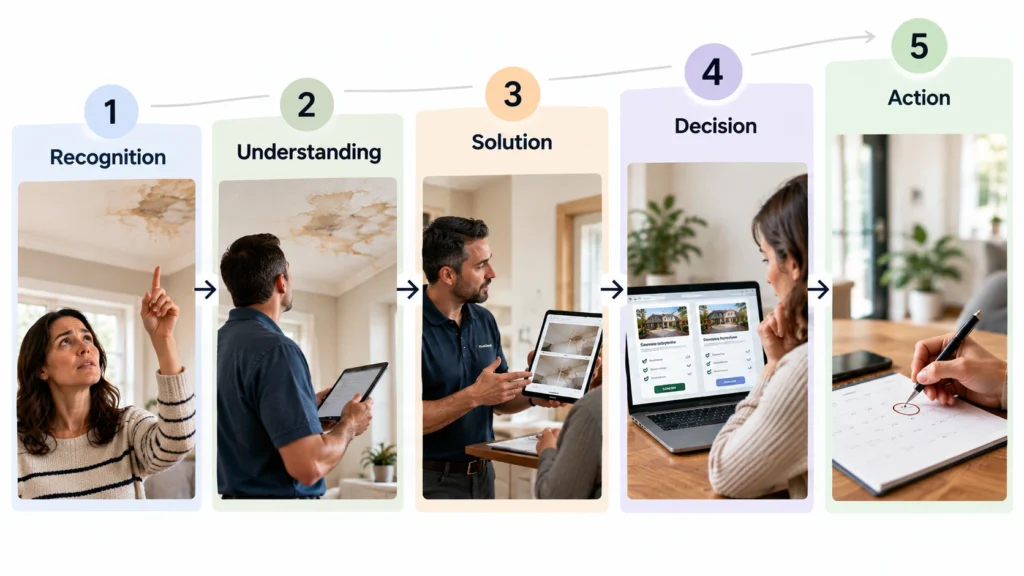
Create a Content Ladder
One useful structure for home service companies is a content ladder.
Start broad and become progressively more specific.
Level 1: Recognition
Help the customer recognize a potential problem.
Level 2: Understanding
Explain possible causes and what the customer may observe.
Level 3: Solution
Explain the common professional approaches.
Level 4: Decision
Explain the factors that influence which approach makes sense.
Level 5: Action
Explain what the customer can do next.
This structure works particularly well when a service is expensive, unfamiliar, or difficult to evaluate.
Turn One Service Into a Month of Content
Suppose an insulation company wants to promote attic insulation.
Instead of producing twenty posts that all say “Improve your insulation,” build a topic cluster.
Post 1: Why some rooms feel hotter or colder than others.
Post 2: What attic insulation actually does.
Post 3: Signs your insulation may need attention.
Post 4: Why insulation levels can vary between homes.
Post 5: What an insulation inspection looks like.
Post 6: How ventilation and insulation can relate.
Post 7: Questions to ask before hiring an insulation contractor.
Post 8: What homeowners should prepare before the work begins.
Post 9: What a completed insulation project should look like.
Post 10: Common misconceptions about insulation.
Now the business has created a learning path rather than a collection of disconnected promotional posts.
Explain What Customers Can Expect
One of the easiest ways to reduce uncertainty is to show the process.
Homeowners often do not know what happens after they contact a service company.
You can explain:
Before the visit: What information the customer should provide.
Arrival: What the technician will typically look at first.
Inspection: What is being evaluated.
Recommendation: How the findings influence the next step.
Work: What the service may involve.
Aftercare: What the customer should know after completion.
The exact process will vary by service, so avoid presenting a generic sequence as if every company operates the same way.
The important idea is transparency.
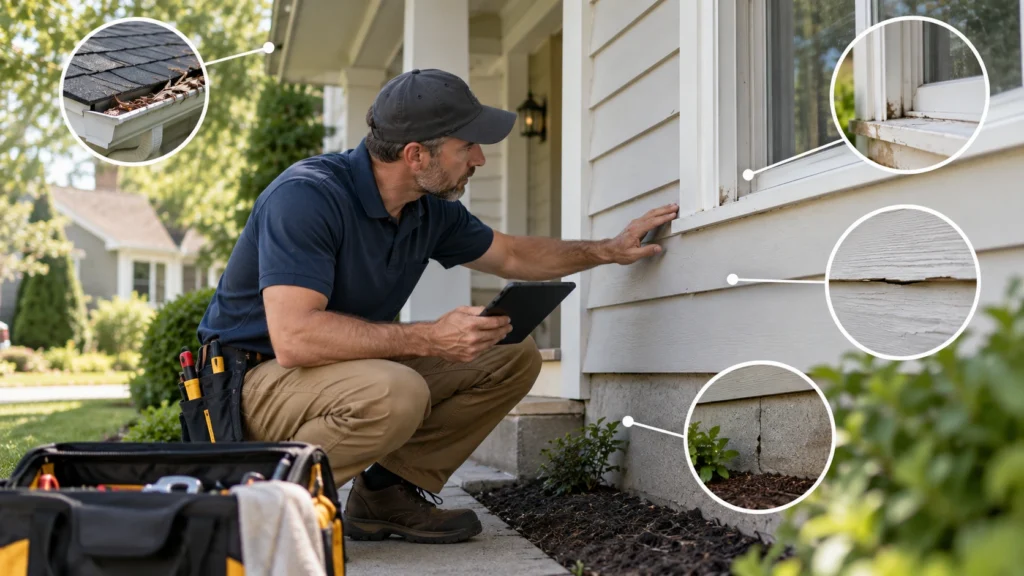
Use “What We Look For” Content
This is one of the strongest content formats for technical businesses.
Instead of telling customers:
“We are experts at foundation repair.”
show them what an expert actually looks for.
For example:
“Five things we check when a basement has recurring moisture.”
Then explain the inspection logic.
This demonstrates expertise without having to announce it.
The customer sees the thinking behind the service.
Explain Recommendations, Not Just Results
Before-and-after content proves that something changed.
It does not necessarily explain why the work was necessary.
That is why project content becomes stronger when it includes reasoning.
Instead of:
“Another successful foundation repair completed.”
Try:
“Water was entering near this section of the foundation. Here is what we found, why the original drainage pattern was contributing to the problem, and what the repair was designed to address.”
The second version teaches.
It also gives the customer more context for understanding the value of the work.
Use the Website as the Deeper Layer
Social content should not be responsible for explaining everything.
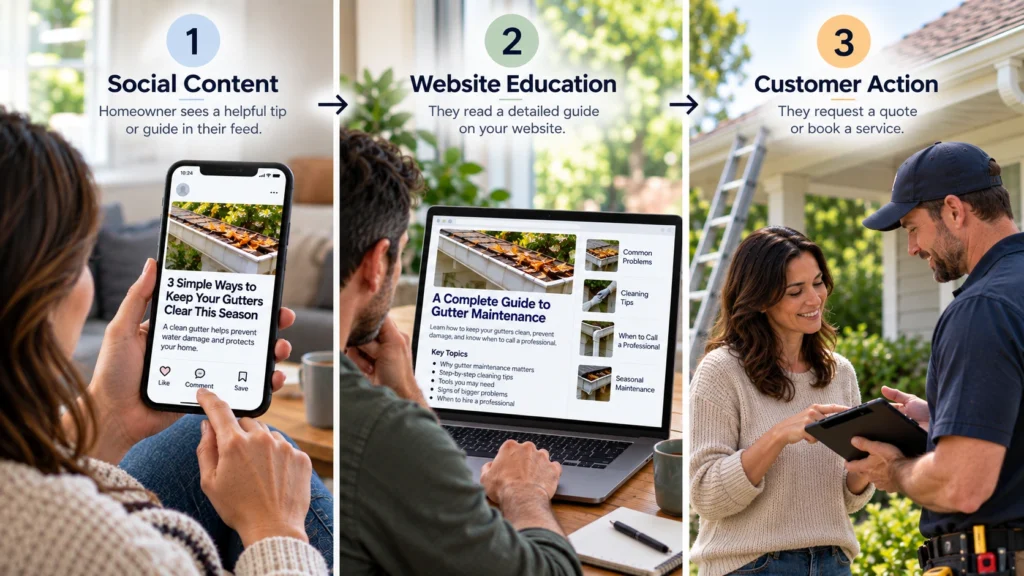
A useful structure is:
Social media = first explanation
Website = deeper explanation
Contact or booking = action
This creates a natural content journey.
Google Business Profile supports posts containing descriptions, photos, videos, and action buttons that can direct people to a website to learn more or complete an action. That gives local service businesses another place to connect educational content with the next step.
Make Your Service Pages Support Your Social Content
There is another strategic opportunity here.
If your social content repeatedly explains the same complex service, the website should have somewhere to continue the conversation.
For example:
A social post explains why a basement can remain damp without visible standing water.
The service page explains the common causes and the company’s approach.
A deeper guide explains the evaluation process.
A contact page gives the customer a practical way to request an inspection.
Now the channels support one another.
The social post is not just an isolated piece of content.
It becomes an entry point.
Use Authentic Project Photos
Home service businesses should take advantage of the work already happening in the field.
But the photos should teach.
Google’s guidance for business-specific photos encourages businesses to use representative images that help customers understand the services they provide.
That fits naturally with home service content.
Show:
- The problem
- The inspection
- The equipment
- The work area
- The process
- The completed result
Where appropriate, explain what the customer is looking at.
A photograph becomes much more useful when the viewer understands why it matters.
Use Short Videos to Explain One Thing
Do not make every video a full service explanation.
Pick one idea.
“Why this pipe keeps freezing.”
“Why your breaker may trip repeatedly.”
“Why one room stays colder.”
“What we check before replacing an AC unit.”
“Why a roof leak may appear far from the actual entry point.”
One video should solve one small understanding problem.
That makes production easier and makes the content easier to consume.
Make Technical Content Feel Human
The difference between professional knowledge and useful content often comes down to language.
Compare:
“Thermal expansion can cause stress at connection points.”
with:
“Why can a pipe make a knocking sound when you turn the water off?”
The second sentence gives the customer something recognizable.
Then the technical explanation can follow.
This is not about avoiding professional language.
It is about introducing professional language at the right moment.
Build Content Around “Should I?”
Some of the most valuable social content answers decision questions.
Should I repair or replace?
Should I wait?
Should I get another inspection?
Should I fix this now or monitor it?
Should I choose the cheaper estimate?
These questions are valuable because they sit close to the customer’s actual decision.
The content should not pretend there is always one universal answer.
Instead, explain the factors that influence the decision.
That is more honest and more useful.
Explain Why Estimates Differ
Price is one of the biggest sources of confusion in home services.
A customer may receive three estimates and wonder why they are so different.
Rather than simply defending your own price, educational content can explain what customers should compare.
For example:
- Scope of work
- Materials
- Labor
- Preparation
- Access
- Warranty terms
- Required permits or code considerations
- What is included
- What is excluded
- Whether additional work may be required
This helps customers compare proposals based on scope instead of simply choosing the lowest number.
Use Customer Questions as Your Content Calendar
Your business probably already receives the best content ideas every day.
They arrive through:
- Phone calls
- Emails
- Estimate requests
- Website forms
- Chat conversations
- Technician conversations
- Sales calls
- Customer objections
Track those questions.
When the same question appears repeatedly, create content around it.
Over time, this can become a practical knowledge library for the business.
Social Content Can Pre-Qualify Understanding
Good educational content can help a customer decide whether your service is actually appropriate.
That is useful.
Someone who reads your content and realizes they need a different type of professional may not become your customer, but the interaction was still valuable.
Someone who understands the problem and recognizes that your service fits may arrive with better questions.
Neither outcome requires aggressive selling.
The content simply helps the customer understand.
Be Careful With Claims and Testimonials
A home service company has strong reasons to show results.
But marketing claims need to remain accurate.
If you use customer testimonials, endorsements, or paid relationships in social content, U.S. consumer-protection guidance from the FTC is relevant. The agency explains that testimonials and endorsements need to be truthful and that certain material relationships need to be disclosed.
That means your content process should include a simple rule:
Never create a stronger claim than the evidence supports.
If a project solved one customer’s problem, describe that project accurately.
Do not turn one project into a universal promise.
Build Content Around the Customer’s Actual Environment
Home service content becomes stronger when it feels specific.
Instead of generic:
“Take care of your plumbing.”
Try:
“Three signs your home’s plumbing may be telling you something is wrong.”
Instead of:
“Maintain your HVAC system.”
Try:
“What to notice when your AC starts running longer than usual.”
Instead of:
“Protect your roof.”
Try:
“What to check after a major storm before you assume your roof is fine.”
The content begins with something the homeowner can recognize.
Measure the Right Signals
Not every useful post will be your most popular post.
For a home service company, a post that gets fewer likes but generates several relevant questions may be more valuable than a highly viewed generic video.
I would track:
- Saves
- Shares
- Meaningful comments
- Direct messages
- Website visits
- Service-page visits
- Estimate requests
- Appointment requests
- Calls influenced by content
- Questions asked by prospects
The exact measurement setup will depend on the channels and systems the business uses.
The important thing is to connect content activity with customer behavior where practical.
A Better Social Strategy for Home Services
The strongest home service social strategy is not necessarily the one with the most posts.
It is the one that answers the questions customers need answered before they feel comfortable making a decision.
That means your content should help people understand:
What is happening?
Why is it happening?
How serious might it be?
What options exist?
What does professional help involve?
How should I compare providers?
What should I do next?
When those questions are answered consistently, the business becomes more useful before the customer ever makes contact.
The Practical Starting Point
If I were planning content for a home service company, I would start with one major service rather than the entire business.
List the ten questions customers ask most often.
Group them into problem, process, decision, preparation, and trust.
Then create a small content series around those questions.
Once that series is working, move to the next service.
That approach is easier to manage, easier to measure, and more useful than trying to publish something different every day simply because the calendar says you should.
Social media becomes much more valuable when it stops being a place where a business announces what it sells and becomes a place where customers learn what they actually need to know.