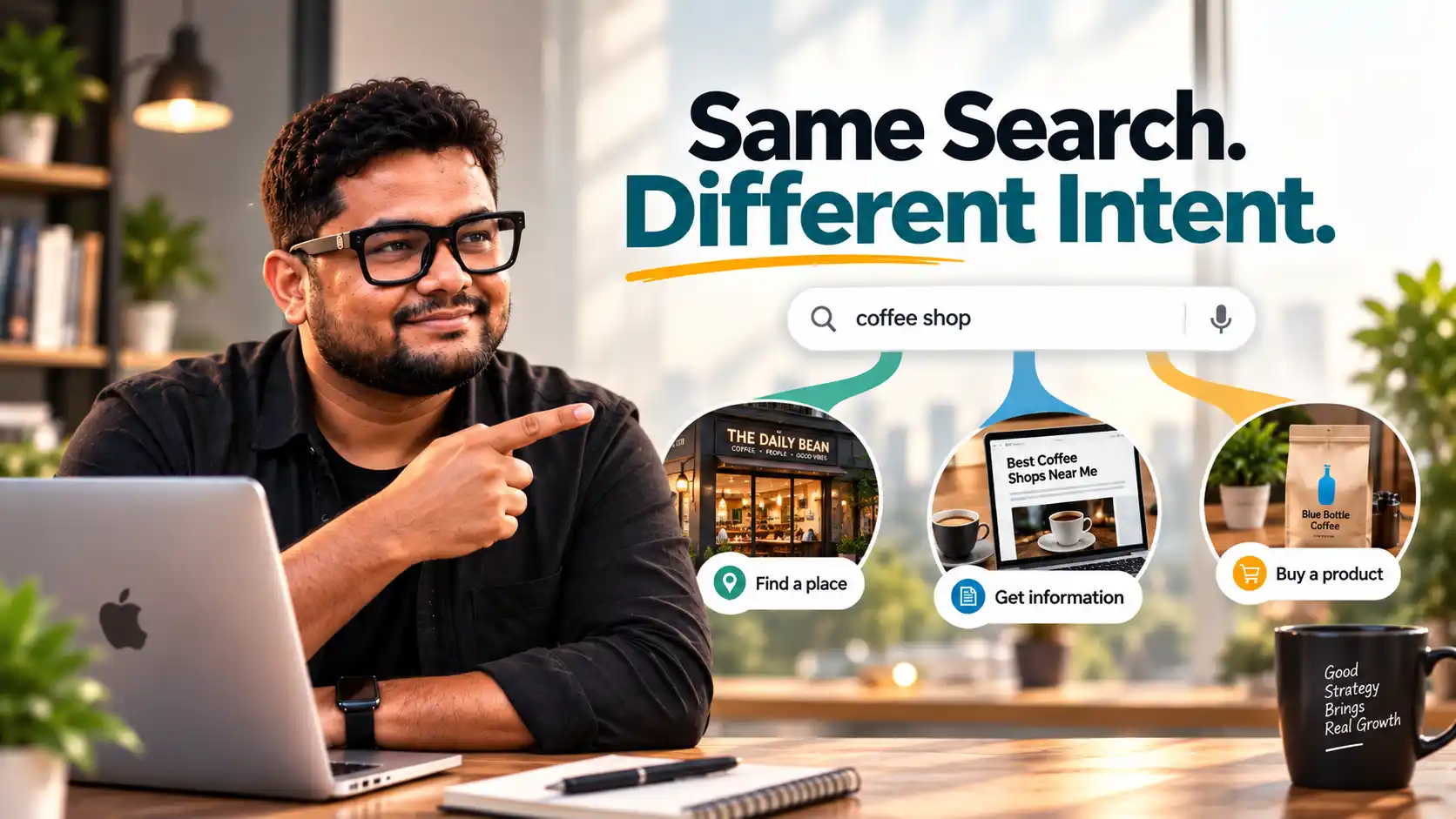
You can create a well-written page, use the right keywords, optimize the title, and still wonder why it is not attracting the kind of visitors you actually want.
Sometimes the problem is not the keyword. It is the intent behind the search.
When someone searches “best accounting software for a small business,” they are in a different situation from someone searching “how to track business expenses.” One person may be comparing options. The other is trying to understand a problem. If your page answers the wrong question, even strong SEO work can bring the wrong visitor or fail to satisfy the visitor you wanted in the first place.
That is why search intent matters. It helps you understand what a person is actually trying to accomplish when they type a query into Google, and it gives you a better way to decide what each page on your website should do.
Search Intent Is Really About the Reason Behind the Search
Search intent is the purpose behind a person’s search.
The words someone types are only part of the story. You also need to think about what they expect to find after pressing Search.
A person searching “what does a website redesign include?” is looking for information. Someone searching “website redesign company” is much closer to evaluating providers. Someone searching for the name of a specific company may simply be trying to reach a particular website.
The wording changes because the goal changes.
For a business owner, this distinction is useful because your website usually contains different types of pages. Your homepage, service pages, blog articles, product pages, location pages, and contact pages do not all need to satisfy the same search purpose.
Trying to make every page rank for every type of search usually creates unfocused content.
Instead, each page should have a clear job.
The Four Search Intent Categories You Will See Most Often
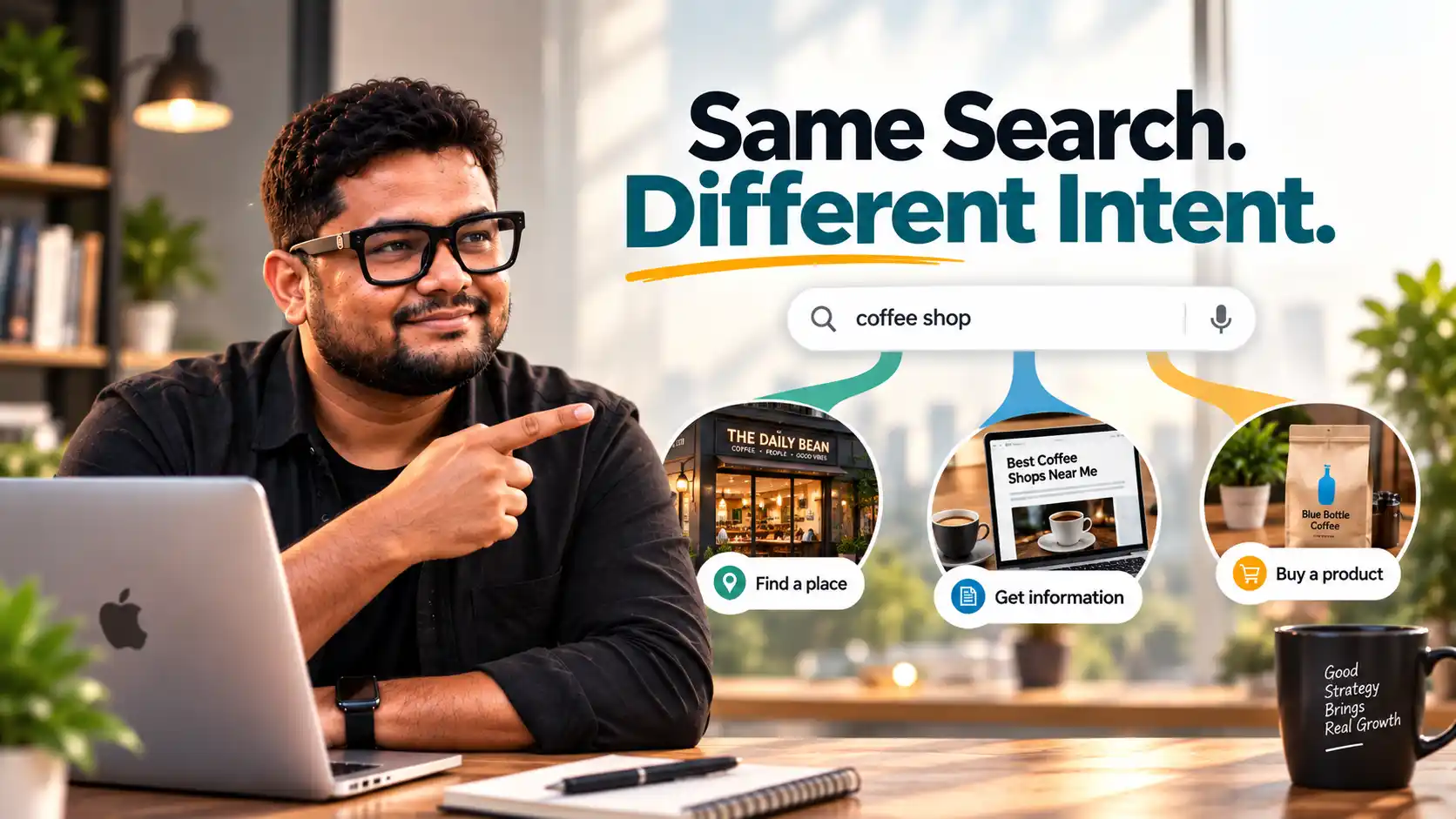
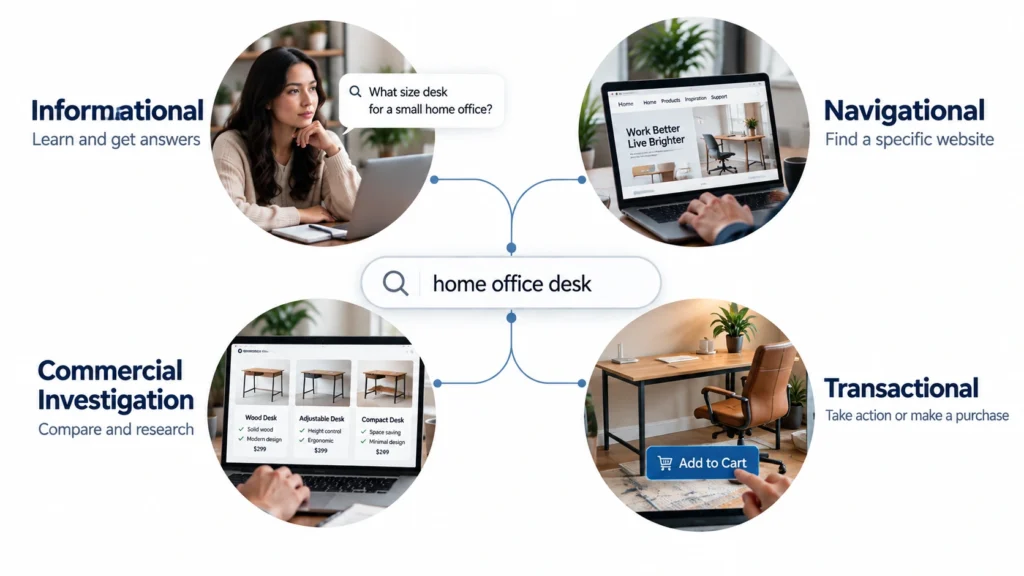
Search intent is commonly discussed through four broad categories: informational, navigational, commercial investigation, and transactional.
These categories are not rigid boxes. A searcher can move from one intent to another during the same buying journey. Still, they are useful when planning content and understanding what a searcher expects.
1. Informational Intent
The person wants to learn something.
Examples include:
- What is search intent?
- How does local SEO work?
- How often should I redesign my website?
- What should a service website include?
- How do abandoned cart emails work?
The person may not be ready to buy anything. They are trying to understand a problem, concept, process, or opportunity.
A blog article, guide, tutorial, explainer, or educational resource is usually more appropriate for this type of search.
If someone searches “what is search intent,” sending them directly to a sales page for SEO services does not address what they asked.
2. Navigational Intent
The person already has a destination in mind.
They may search for:
- Google Search Console
- Shopify login
- Akai Solution
- a particular company name
- a specific tool or website
The goal is generally to reach a known website, platform, brand, or page.
This type of search is less about discovering a new idea and more about finding a specific destination.
3. Commercial Investigation
This is where the searcher is researching before making a decision.
Examples might include:
- WordPress vs Webflow for a service business
- best website platform for a consulting business
- Shopify vs WooCommerce
- website redesign agency
- email marketing platforms for ecommerce
The person may not be ready to purchase immediately, but they are evaluating options.
This is an important stage for business websites because a visitor comparing solutions needs different information from someone who is simply learning what a solution means.
Clear comparisons, service explanations, examples, decision criteria, pricing information when appropriate, and evidence of capability can all become relevant here.
4. Transactional Intent
The person is ready to take an action.
That action could be:
- Buy a product
- Book an appointment
- Request a quote
- Sign up for a service
- Start a free trial
- Contact a provider
For these searches, the page needs to make the next action clear.
If someone searches for “book a facial near me,” a long educational article about the history of facials is unlikely to be what they need at that moment. They may want availability, location, services, pricing, and an easy way to book.
The page needs to match the situation.
Why Search Intent Matters More Than Simply Adding Keywords
A common SEO mistake is to think of a keyword as something you place into a page.
But a keyword represents a question, need, problem, or decision.
Imagine you offer website redesign services and want to target the phrase “website redesign.”
There are several possible reasons someone could search that phrase. They might want to understand what redesign means, see examples, compare redesign providers, learn how much a redesign costs, or find someone to handle the project.
A single generic page cannot realistically satisfy every one of those needs equally well.
This is why search intent should influence the type of page you create, not just the words you place on that page.
Search Intent Helps You Decide What a Page Should Actually Do
Before creating a page around a keyword, ask a more useful question:
What does the searcher need from this page?
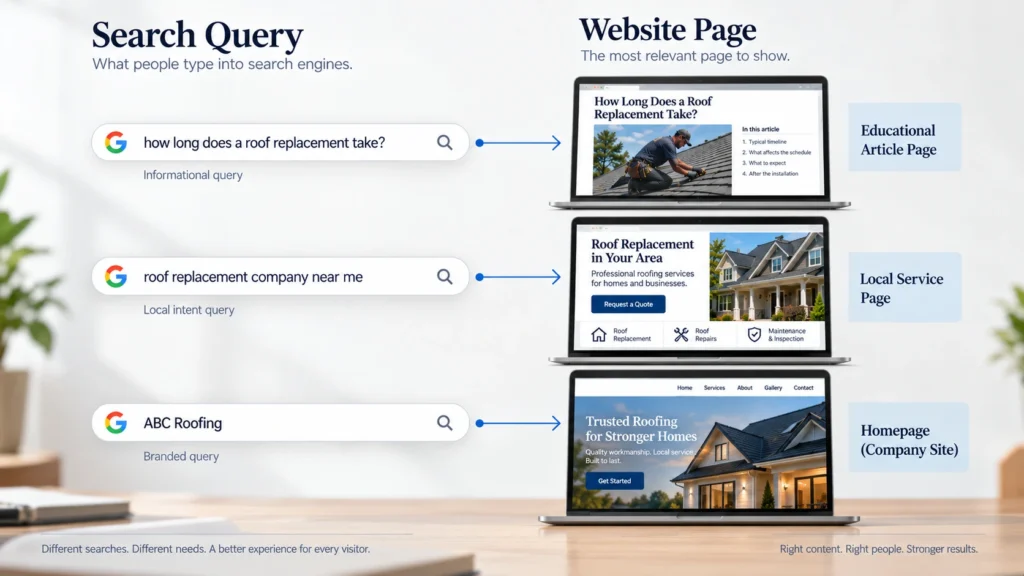
Suppose you run a roofing company.
Someone searches:
“How long does a roof replacement take?”
That search suggests an informational need. An article explaining the factors that affect the timeline could be appropriate.
Now consider:
“Roof replacement company near me”
The situation is different. The searcher is likely looking for providers and deciding who to contact.
A service or location page makes more sense.
Then consider:
“ABC Roofing”
That is primarily navigational. The person may already know the company and simply want to reach its website.
The business, keyword, and industry have not changed. The searcher’s situation has.
That is the part worth paying attention to.
Your Search Results Page Can Tell You a Lot
One practical way to investigate search intent is to search the query yourself and study the results.
Look at the pages that appear prominently. Are they mostly:
- Blog articles?
- Product pages?
- Service pages?
- Category pages?
- Comparison guides?
- Local business results?
- Official documentation?
- Videos?
- Forums or discussions?
The result page gives you useful evidence about what search engines are currently showing for that query.
It does not mean you should copy those pages. It means you can study the type of information the search results suggest people are looking for.
Google’s own Search documentation also emphasizes creating useful, people-first content rather than producing pages primarily to manipulate search rankings. Google Search Central’s guidance on people-first content
That distinction is important. Search intent is not about finding a formula for ranking. It is about understanding the person behind the search.
Search Intent Can Change as Someone Moves Toward a Decision
A customer journey rarely begins with “I am ready to buy.”
A person might first search:
“How does email automation work?”
Then:
“Best email automation tools”
Then:
“Klaviyo vs Mailchimp”
And eventually:
“Klaviyo setup service”
The subject is related, but the intent changes.
This is why a business website can benefit from having different pages that support different stages of the journey.
An educational article can answer the first question. A comparison guide can support the second and third. A service page can address the final commercial need.
You do not have to force one page to do all of this.

Match the Page Type to the Searcher’s Need
A simple way to think about it is:
| Searcher’s situation | Likely intent | Useful page type |
| Wants to understand something | Informational | Blog, guide, tutorial |
| Wants to find a known destination | Navigational | Homepage, brand page, specific destination |
| Is comparing options | Commercial investigation | Comparison, service page, buying guide |
| Is ready to act | Transactional | Product, booking, service, contact page |
This is not a rigid SEO formula. Some searches overlap, and the right page type depends on the query and context.
The point is to stop treating every keyword as if it requires the same kind of page.
Search Intent Also Improves Your Website Structure
Once you understand what different visitors are trying to accomplish, your website architecture becomes easier to plan.
You may discover that your website needs:
- Educational content for common questions
- Service pages for specific solutions
- Comparison content for people evaluating options
- Product or booking pages for visitors ready to act
- Supporting pages that answer objections and build trust
This creates a more logical journey.
Someone can discover an educational article, learn about the problem, explore a relevant service, compare their options, and eventually reach a page where taking action makes sense.
That is much more useful than publishing dozens of disconnected articles simply because the keywords looked attractive.
Do Not Assume the Keyword Tells You Everything
Search queries can be surprisingly ambiguous.
Consider:
“Email marketing.”
What does the person want?
They could be looking for a definition, software, strategy, examples, a course, an agency, or a way to send their first campaign.
Now compare it with:
“email marketing automation for ecommerce.”
The context becomes more specific.
Or:
“email marketing automation agency.”
The commercial intent becomes much clearer.
The more specific the query becomes, the easier it may be to understand what the searcher is trying to accomplish. But you should still examine the actual search results before deciding what kind of page to create.
Search Intent Should Influence Your Content Before You Write
One of the easiest ways to waste time with SEO is to start writing before deciding what the page is supposed to accomplish.
Instead, work backwards.
Start with the search query. Then ask:
- What is the person trying to accomplish?
- What information would satisfy that need?
- What type of page is appropriate?
- What questions would naturally follow?
- What should the visitor be able to do after reading?
- Does the existing search landscape support this page type?
Only then should you start outlining the content.
This approach also helps prevent keyword stuffing because the focus moves away from repeating a phrase and toward answering the actual question.
What Search Intent Means for Service Business Websites
For service businesses, search intent can be particularly useful because different pages often support different customer decisions.
A service page may need to explain what you provide, who it is for, what the process looks like, and what the next step is.
A blog article may need to answer a question without immediately pushing the service.
A comparison page may need to help someone understand which option fits their situation.
A location page may need to make local relevance and service availability clear.
Each page has a different job.
If every page is written like a sales page, informational visitors may feel pressured. If every page is written like an educational article, visitors who are ready to act may struggle to find the next step.
The goal is not to make every page convert in exactly the same way.
The goal is to make every page useful for the person who lands there.
Use Search Intent to Find Content Gaps
Search intent can also reveal gaps in your existing website.
Imagine your website has ten service pages but almost no useful educational content. You may be missing people who are still researching their problem.
Or perhaps you publish many educational articles but have weak service pages. You may be attracting people who learn from you but cannot easily understand what you actually offer.
Another common gap appears between education and action.
A visitor may understand the problem but still have unanswered questions before contacting you. A comparison article, process page, FAQ, or decision guide may help bridge that gap.
This is where search intent becomes more than an SEO concept. It becomes a way to evaluate whether your website supports the full customer journey.
The Goal Is Not to Guess the Algorithm
Search intent should not become another SEO obsession where you spend hours trying to predict exactly what Google wants.
The more useful question is simpler:
What would genuinely help the person who made this search?
Google’s current search guidance continues to emphasize useful, reliable content created for people, while its spam policies specifically warn against producing large amounts of unoriginal content primarily to manipulate search visibility. Google Search Central’s Search Essentials and spam guidance
That aligns with a sensible content strategy anyway.
If a person searches for an answer, give them a useful answer. If they are comparing options, help them compare. If they are ready to act, make the next step clear.
How to Apply Search Intent to Your Website
You do not need to rebuild your entire content strategy overnight.
Start with the pages that matter most to your business.
Pick a few important search queries and review the current search results. Identify the dominant intent, compare it with the page you currently have, and ask whether your page actually satisfies that need.
Then look at the gap.
Maybe your page is too commercial for an informational search. Maybe it is too general for a specific service query. Maybe the content answers the question but gives the visitor no sensible next step.
Those are useful problems to discover because they tell you what needs to change.
The Practical Takeaway
Search intent is ultimately about understanding why someone searched before deciding what your website should say. Once you start looking at searches through that lens, SEO becomes less about inserting keywords and more about creating the right page for the right situation.
For a small business owner, that can make content planning much clearer. Instead of asking, “What keyword should I put on this page?” you can ask, “What is this person trying to accomplish, and is my page actually helping them do it?”
That shift can improve more than your content strategy. It can also make your website easier to navigate, your pages more relevant to visitors, and your next SEO decision much easier to make.