A small business website can have plenty of content and still struggle to attract the right visitors.
You might have blog posts, service pages, FAQs, location pages, and social media content. You may even have done keyword research.
But there is another question worth asking:
Does each piece of content match what the person searching actually wants?
That is the basic idea behind search intent.

For small businesses, search intent is not just an SEO concept. It is a practical way to decide what pages to create, what information to include, and what a visitor should be able to do next.
What search intent means in practical terms
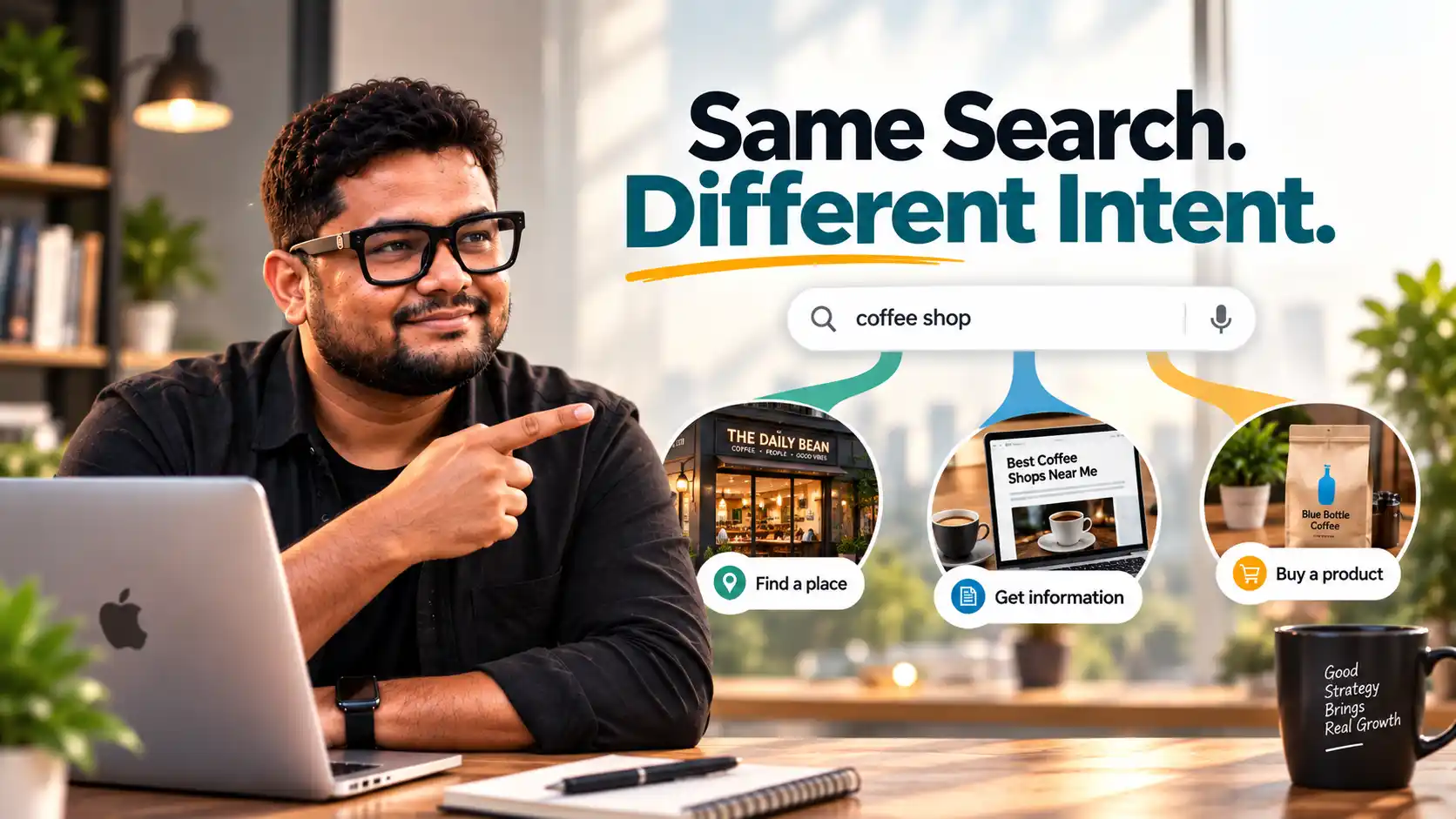
Search intent is the purpose behind a person’s search.
When someone searches “how to improve website speed,” they are probably looking for information or instructions.
When someone searches “website speed optimization service,” the situation is different. They may be evaluating providers.
When someone searches for the name of a specific company, they are probably trying to reach that company.
The wording matters, but the desired outcome matters more.
A useful content strategy therefore starts by asking:
What does this visitor want to accomplish?
That question can influence everything from the page format to the call to action.
Why this matters more for small businesses
Small businesses often have limited resources.
You may not have a large SEO team researching hundreds of topics every month. You may be managing the website, marketing, customer communication, and day-to-day business at the same time.
That means every page should have a reason to exist.
Instead of publishing content simply because a keyword has search volume, think about what role that content plays.
A useful page might:
- Answer a customer question
- Explain a confusing service
- Help someone compare options
- Address an objection
- Demonstrate expertise
- Help a visitor decide what to do next
- Support a service or product page
That is a more useful way to think about content investment.
The four search intent categories businesses can use
There are many SEO frameworks for classifying search intent. For practical small business planning, four categories are particularly useful.
Informational
The person wants to learn.
Examples include:
- What is email automation?
- How does local SEO work?
- How often should a business update its website?
- What is a responsive website?
This type of search is often a good fit for educational content.
The business opportunity is not necessarily immediate conversion. The goal may be to become a useful source of information and build familiarity.
Navigational
The person wants to reach something specific.
Examples:
- Google Search Console
- Shopify
- A business name
- A specific website
- A specific location
For businesses, navigational searches reinforce the importance of brand visibility and clear online information.
If someone already knows your company name but struggles to find the right website page, your problem is not necessarily content volume. It may be information architecture or online presence.
Commercial investigation
The person is evaluating options.
Examples:
- Best website builder for a small business
- Shopify vs WooCommerce
- Best CRM for contractors
- Website redesign cost
- Elementor vs another page builder
This type of content should help the visitor evaluate.
That means honest comparisons, useful criteria, realistic trade-offs, and clear explanations are often more valuable than aggressive promotion.
Transactional
The person is ready or close to ready to act.
Examples:
- Book a photographer
- Hire a website designer
- Buy accounting software
- Schedule a consultation
- Order flowers near me
This is where the destination page becomes particularly important.
If the visitor wants to hire, give them a service page.
If they want to book, give them a booking path.
If they want to buy, give them a product or checkout experience.
It sounds simple, but many websites create friction by sending action-oriented visitors to pages that were designed mainly for education.
The same business can need different content for different intents
Imagine a local home remodeling company.
It could create:
Informational content:
“How Much Does a Kitchen Remodel Usually Involve?”
Commercial content:
“Kitchen Remodeling Options: What Should Homeowners Compare?”
Transactional page:
“Kitchen Remodeling Services”
All three can belong to the same website.
But they have different jobs.
The educational article can answer questions.
The commercial guide can help someone evaluate options.
The service page can explain the actual offering and make it easy to take the next step.
This is how search intent can turn a collection of pages into a more intentional content system.
Search intent should influence your content format
One of the most practical benefits of understanding intent is that it helps you choose the right format.
| Searcher’s goal | Content format to consider |
| Learn | Guide, article, tutorial |
| Compare | Comparison guide |
| Decide | Buying or decision guide |
| Find a business | Homepage, location page, profile |
| Understand a service | Service page |
| Take action | Booking, contact, product, or service page |
| Solve a specific problem | Problem-solving guide |
These are starting points, not strict rules.
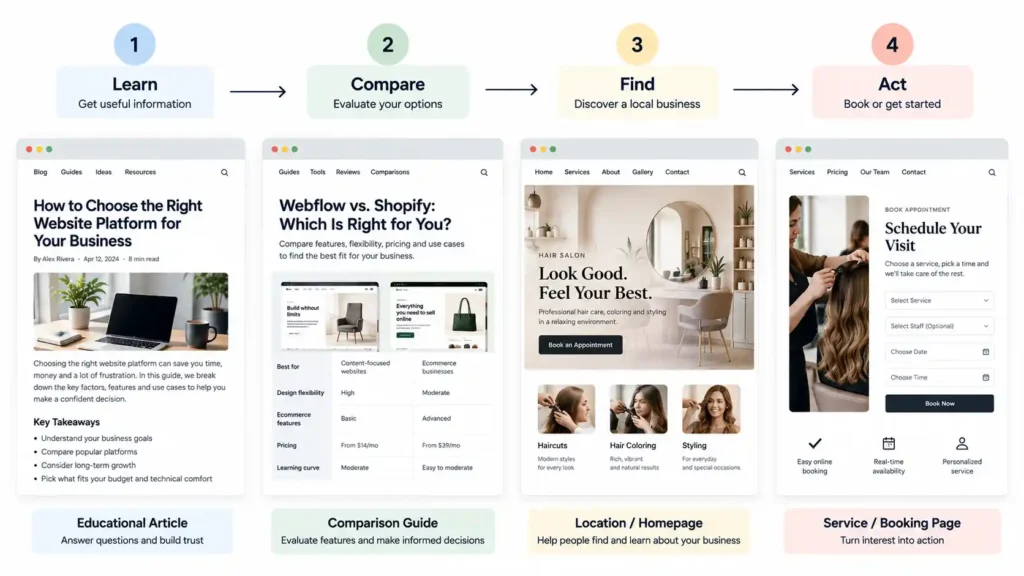
Search results vary, and one query can have mixed intent.
The important thing is to make the page format serve the visitor.
Do not confuse search intent with keywords
A keyword can tell you what someone typed.
It does not always tell you why they typed it.
Take the phrase “website designer.”
One person may be looking for inspiration.
Another may be researching the profession.
Another may want to hire someone.
Another may be looking for a local provider.
Another may be comparing prices.
If you build a page around the phrase without understanding the context, you can easily create something that looks relevant but feels unhelpful.
That is why search intent should be considered alongside:
- Search results
- Search wording
- Business goals
- Customer questions
- Page type
- Conversion path
- Existing website structure
How to identify search intent before creating content
You do not need an expensive process.
Start with the search itself.
Step 1: Read the query like a customer
Do not immediately analyze it as an SEO professional.
Ask what a normal person might mean.
Step 2: Look at the existing search results
What types of pages are appearing?
Are they guides?
Service pages?
Product pages?
Local results?
Comparisons?
The results can provide useful clues about the kind of answer searchers expect.
Step 3: Look for the unanswered question
Sometimes the obvious keyword is not the real opportunity.
For example, if people search for “website redesign cost,” they may also want to know:
- What is included?
- How long does it take?
- What affects the price?
- Should I redesign or start over?
- How many pages do I need?
- What happens to SEO during a redesign?
Those questions can become part of the content strategy.
Step 4: Decide what the visitor should do next
If the visitor is only researching, do not immediately push a sales form.
If the visitor is ready to contact you, do not hide the contact option beneath a giant educational article.
Match the next step to the intent.
Search intent can improve service pages too
Search intent is not just for blog articles.
It can help you improve commercial pages.
Suppose you offer website redesign services.
A weak service page might simply say:
“We design modern websites for businesses.”
A stronger page would address the actual questions someone considering the service may have:
- When does a redesign make sense?
- What problems can a redesign solve?
- What happens during the process?
- What does the client need to provide?
- What happens to existing content?
- How should SEO be handled?
- What happens after launch?
The more clearly the page addresses real decision-making questions, the more useful it becomes.
Search intent can improve website navigation
It can also influence how your website is organized.
If visitors commonly need to:
- Understand the problem
- Explore solutions
- Review services
- Contact the business
then the website should make those paths easy to follow.
This does not mean every website needs a complicated funnel.
Often, the opposite is better.
A clear navigation structure with useful page relationships can make the journey easier.
What not to do
Understanding search intent can prevent several common mistakes.
Do not create pages just to target keyword variations
If two queries represent essentially the same need, separate pages may not add much value.
Do not make informational pages sound like sales brochures
Someone asking a basic question should be able to learn without feeling pressured.
Do not send every visitor to your homepage
The homepage is not the correct destination for every search.
Do not hide the next step
Educational content should still help a reader understand what they can do next when appropriate.
Do not assume high search volume means high business value
A large audience is not automatically the right audience.
A smaller search with strong relevance to your service may be more valuable to a small business than a broad topic attracting thousands of unrelated visitors.
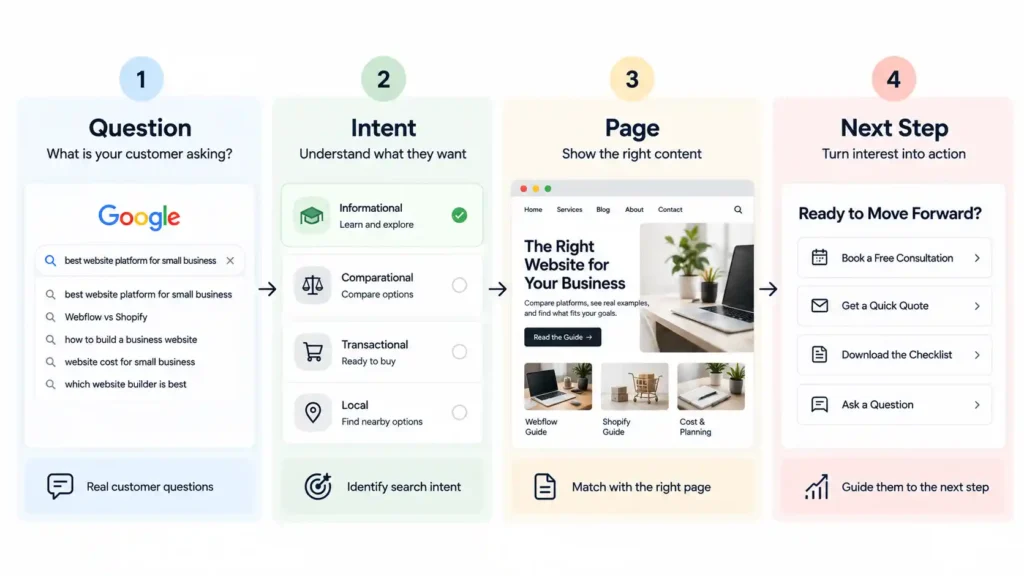
A simple framework for planning small business content
A useful way to organize content is:
Question → Intent → Page → Next Step
For example:
“How does local SEO work?”
→ Informational
→ Educational guide
→ Explore local SEO service
“Best website platform for a small business?”
→ Commercial investigation
→ Comparison guide
→ Review recommended implementation options
“Website redesign service”
→ Transactional
→ Service page
→ Contact or consultation
This simple framework can prevent content planning from becoming a keyword spreadsheet with no business context.
Search intent and the bigger picture
Search intent should not replace keyword research, technical SEO, website performance, conversion optimization, or good design.
It connects them.
A technically strong website still needs useful content.
A beautiful website still needs clear information.
A well-researched keyword still needs the right page.
A high-ranking page still needs to satisfy the person who clicks it.
Google’s current guidance emphasizes unique, useful, trustworthy content that serves people, and its current Search documentation continues to reinforce people-first quality rather than tactics designed simply to manipulate rankings. Google Search Central’s current guidance
That is a useful principle for small business websites because your website should work for people first.
Search intent gives small business owners a practical way to think about content.
Instead of asking only:
“What keyword should I rank for?”
ask:
“What is this person trying to accomplish, and what would actually help them?”
That change sounds small, but it can influence the entire content strategy.
You may discover that you need fewer articles and better service pages.
You may discover that a comparison guide is more useful than another generic blog post.
You may discover that your website needs clearer navigation rather than more content.
Most importantly, you start building around customer needs instead of simply building around keywords.
That is where search intent becomes useful beyond SEO.