
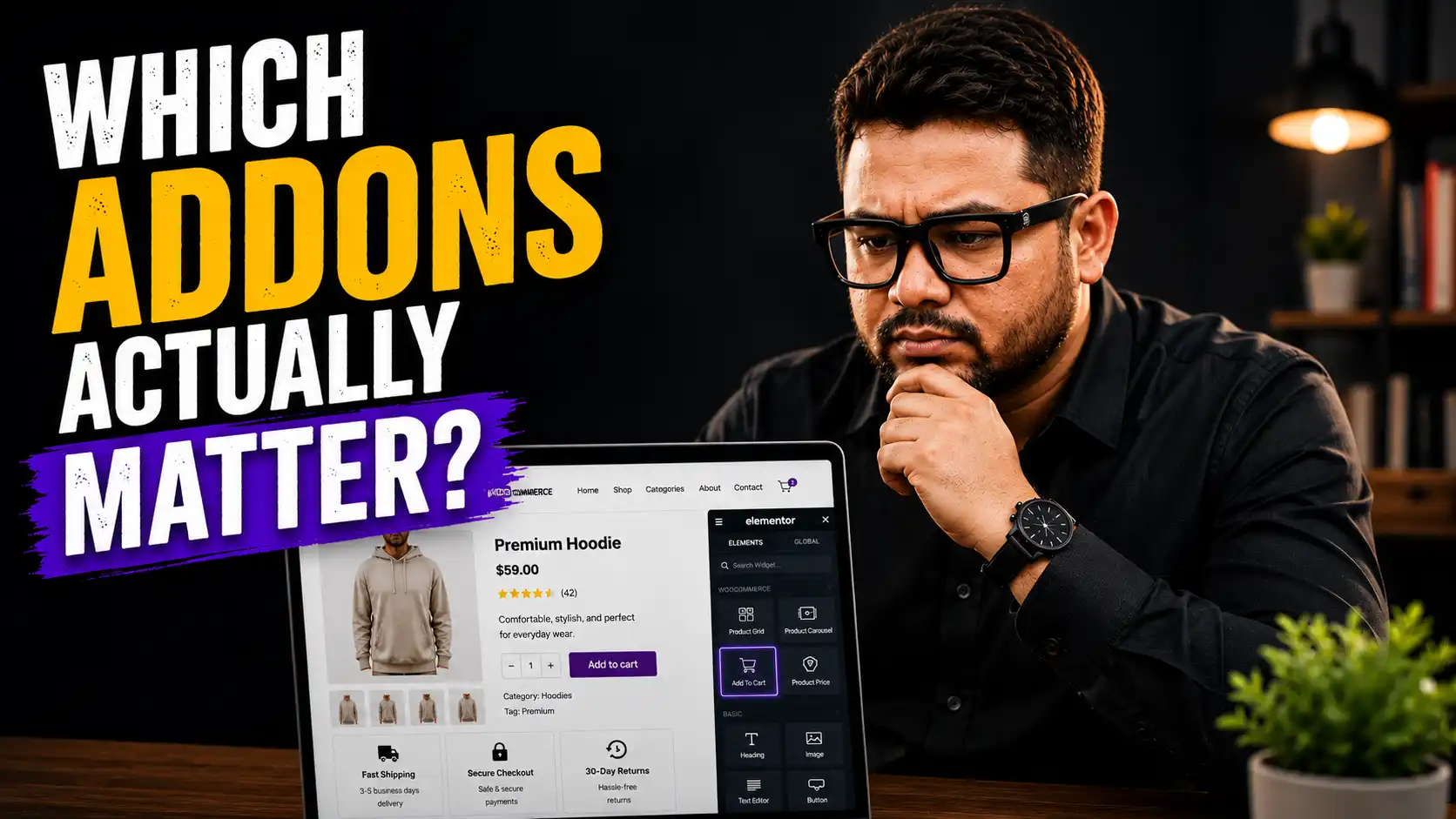
A WooCommerce store can look completely different from one business to another.
A small skincare shop may need beautiful product cards and better product-page layouts. A fashion store may need variation swatches and filtering. A larger catalog may need advanced search, comparison tools and a more customized shopping journey.
So when someone asks, “What is the best Elementor addon for WooCommerce?” there is no useful one-size-fits-all answer.
The better question is:
What does your store need to do that your current Elementor and WooCommerce setup cannot do well?
That should be the starting point for your decision.
First, Check What Elementor Already Gives You
Elementor’s current WooCommerce functionality is more extensive than many store owners realize.
Depending on the Elementor plan, its WooCommerce tools cover product pages, archives, cart, checkout, My Account, menu cart and a range of product-related widgets.
That means adding a third-party addon should be a deliberate decision.
If you only want to change the visual arrangement of your product page, you may already have what you need.
If you need advanced filtering, comparison, additional WooCommerce widgets or specialized shopping features, an addon may make sense.
The Elementor Addons Worth Considering

Essential Addons for Elementor
Essential Addons is a practical option when you want a broader Elementor extension with dedicated WooCommerce functionality.
Its WooCommerce toolkit includes product-focused widgets, and its current documentation shows continued development around product titles, descriptions, tabs and other store elements.
Good fit for: businesses that want a broad Elementor toolkit without building their site around several small plugins.
ShopEngine
ShopEngine is more specifically focused on WooCommerce.
Current product information and independent comparisons describe features for shop, product, cart, checkout and My Account layouts, alongside shopping features such as wishlist, quick view, comparison and variation swatches.
Good fit for: stores that need deeper WooCommerce template customization.
ShopLentor
ShopLentor is another option when you want a broad collection of WooCommerce-specific tools.
Its main attraction is breadth. That can be useful for stores with more complex requirements, but it also means you should be selective about which functionality you actually activate.
Good fit for: stores looking for a wider WooCommerce toolkit.
The Plus Addons for Elementor
The Plus Addons is particularly interesting for more design-intensive WooCommerce projects.
Its WooCommerce Store Builder covers multiple areas of the shopping experience, including product, cart, checkout, My Account and thank-you pages.
Good fit for: businesses where the storefront experience needs substantial customization.
Premium Addons for Elementor
Premium Addons provides WooCommerce widgets including product listings, categories, CTA elements, mini cart and conditional display functionality.
Good fit for: stores that need flexible WooCommerce widgets without necessarily adopting a dedicated store-builder approach.
What Should You Choose?
Instead of ranking everything from one to five, I would match the addon to the business requirement.
| Your Requirement | What to Consider |
| Basic WooCommerce customization | Elementor Pro |
| More general Elementor widgets | Essential Addons |
| Dedicated WooCommerce templates | ShopEngine |
| Large WooCommerce toolkit | ShopLentor |
| Advanced store design | The Plus Addons |
| Flexible WooCommerce widgets | Premium Addons |
This approach is more useful than simply asking which plugin has the most features.
A Common Mistake: Installing Too Many Addons
I see a common pattern with WordPress websites.
A store owner needs one feature.
They install one plugin.
Then another plugin offers a better product grid.
Another provides a wishlist.
Another provides filters.
Another changes the cart.
Eventually, the site has several overlapping Elementor extensions.
The problem is not that any one plugin is necessarily bad.
The problem is the growing complexity of the website.
More dependencies mean more things to review when WordPress, WooCommerce, Elementor or another plugin gets updated.
That is why I prefer a simple rule:
Every plugin should have a clear job.
If two plugins solve the same problem, compare them and keep the one that fits the site better.
What About Website Speed?
Do not assume that an addon automatically makes a website slow.
But do not assume it has no impact either.
A WooCommerce store has many moving parts. Product images, scripts, CSS, third-party integrations, theme features, hosting, plugins and page structure can all influence performance.
The sensible approach is to test.
Before and after installing an addon, check important pages such as:
- Homepage
- Shop page
- Product page
- Cart
- Checkout
- Mobile layouts
If the addon provides selective widget loading or asset controls, use them where appropriate.
The Right Way to Evaluate an Addon
Before installing anything, answer five questions.
1. What problem am I solving?
Be specific.
2. Does Elementor already solve it?
If yes, do not add another plugin simply because it looks interesting.
3. Does this addon solve the entire problem?
Avoid collecting several partial solutions.
4. Is it actively maintained and compatible with my setup?
Check current documentation, update activity and compatibility before relying on it.
5. Does the benefit justify another dependency?
That final question is often ignored.
A feature may be useful, but not useful enough to justify another plugin on a production store.
The best Elementor addon for a WooCommerce store is not necessarily the one with the largest widget library.
It is the one that fits your business requirements, works reliably with your current stack and gives you meaningful control without unnecessary complexity.
For a general Elementor extension, start by evaluating Essential Addons.
For WooCommerce-focused template building, look closely at ShopEngine.
For a broad WooCommerce feature set, consider ShopLentor.
For advanced store design, evaluate The Plus Addons.
For flexible WooCommerce widgets, Premium Addons is another option.
And before installing any of them, check whether Elementor Pro already solves your requirement.
A better WooCommerce store does not come from installing more plugins.
It comes from choosing the right tools for the problems your customers actually experience.