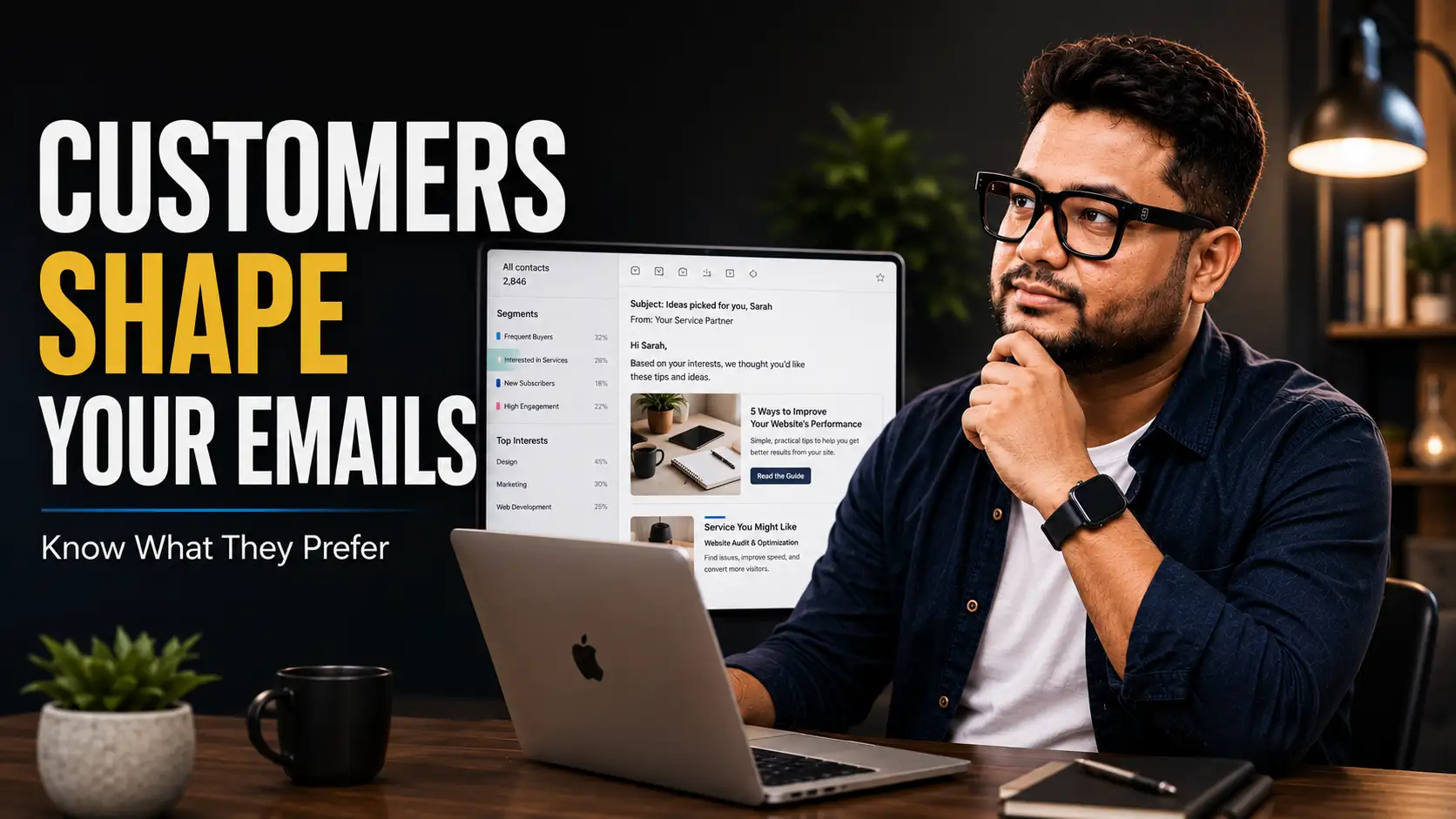
A service business can have thousands of email subscribers and still struggle to make its emails feel relevant.
The problem is not always the email template.
It may be the strategy behind the content.
A new lead researching a service has different needs from an existing customer.
A customer who recently completed a project may need follow-up information.
A prospect who repeatedly clicks on one service may be showing a stronger buying signal.
Yet if all three receive exactly the same email, the business is ignoring useful information it already has.
Customer preferences can help service providers make email communication more relevant, practical, and timely.
The Business Problem: One Audience Is Rarely One Audience
A service provider may look at an email list as one audience.
From a database perspective, that makes sense.
From a customer perspective, it often does not.
Consider a small home service company.
Its email database could include:
- New leads
- Existing customers
- Past customers
- Quote requests
- High-intent prospects
- Inactive subscribers
Each group may have a different relationship with the business.
That relationship should influence the content they receive.
Customer Data Should Lead to Better Communication
The purpose of collecting customer information should not be to build a larger database.
It should be to understand customers well enough to communicate more effectively.
Useful information can include:
- Service interest
- Previous purchases
- Service frequency
- Email engagement
- Link clicks
- Website behavior
- Customer lifecycle stage
- Declared content preferences
Not every business needs all of these.
The right question is:
Which customer differences actually change what we should communicate?
That question keeps the strategy practical.
Behavior Can Reveal Intent
Suppose a customer repeatedly clicks emails about a particular service.
That does not guarantee they are ready to buy.
But it is a useful signal.
Another subscriber may regularly engage with educational content but ignore promotions.
That may suggest a different communication approach.
Someone who has just completed a service may respond better to follow-up and maintenance information than another promotional offer.
Behavior can therefore help businesses move from assumptions toward more informed communication.
Data becomes useful when it changes a business decision.
If collecting a piece of information does not change what you send, when you send it, or how you communicate, its value may be limited.
Segmentation Creates Practical Relevance
Service businesses do not need dozens of audience segments to get started.
A few useful groups can be enough.
New Leads
Focus on:
- Education
- FAQs
- Service explanations
- Trust
- Common customer concerns
Existing Customers
Focus on:
- Follow-up
- Maintenance
- Helpful tips
- Related services
- Retention
High-Intent Prospects
Focus on:
- Specific questions
- Service details
- Objection handling
- Next steps
- Relevant proof
Inactive Subscribers
Focus on:
- Re-engagement
- Useful content
- Preference updates
- Reduced promotional pressure
The goal is not segmentation for its own sake.
The goal is better communication.
Customer Preferences Can Improve the Customer Journey
Email is one part of the customer journey.
It should support what the customer is trying to accomplish at each stage.
Awareness → Interest → Consideration → Purchase → Retention
A person in the awareness stage may need education.
Someone considering a purchase may need answers.
A customer who has already purchased may need guidance on what to do next.
A long-term customer may be ready for related services or retention communication.
Customer preferences and behavior can help the business determine which type of message makes the most sense.
Personalization Should Change the Message, Not Just the Name
Adding a customer’s first name to an email can be useful.
But it is not the heart of personalization.
Real personalization may change:
The topic.
The example.
The offer.
The call to action.
The timing.
Imagine a customer who previously booked lawn maintenance.
Instead of sending:
“Explore our services.”
the business could send:
“Planning your seasonal cleanup? Here’s what homeowners should prepare before the next visit.”
The second email feels more relevant because it connects with the customer’s context.
Timing Is Part of Relevance
Even a useful message can fail if it arrives at the wrong time.
A customer who just completed a service may need instructions or follow-up information.
A seasonal service customer may need a reminder before demand increases.
A prospect who requested information may need educational content before receiving another sales message.
Timing should reflect the customer situation whenever practical.
This is where automation can become useful.
But automation should follow the customer journey, not replace strategic thinking.
Ask Customers Instead of Guessing Everything
Businesses often try to infer preferences from behavior.
Sometimes that works.
But declared preferences can be even clearer.
A service provider can ask subscribers what they want to receive.
For example:
Choose the content that interests you:
- Service tips
- Maintenance advice
- New services
- Special offers
- Industry information
- Company updates
This can improve customer control and give the business useful segmentation data.
Do Not Turn Preference Data Into a Sales Machine
This is an important distinction.
If a customer shows interest in a service, the answer should not automatically be five promotional emails about that service.
That can quickly become annoying.
Instead, the business can use the interest signal to provide helpful information.
Explain the process.
Answer common questions.
Share maintenance advice.
Discuss what customers should look for.
Explain what happens before and after the service.
Then, when an offer genuinely makes sense, the customer is already receiving relevant context.
Technology Should Support the Strategy
Platforms such as Mailchimp, Klaviyo, and Brevo can help businesses manage segmentation, automation, personalization, and email workflows.
But technology should not determine the strategy.
Start with:
Customer difference → Communication need → Relevant content → Appropriate timing
Then decide what technology is required.
This prevents businesses from building complicated automation simply because their platform makes it possible.
A Simple Implementation Plan
Step 1: Review Your Current Audience
Identify the customer groups that actually have different needs.
Step 2: Find Useful Signals
Review service history, inquiries, email engagement, clicks, and declared preferences.
Step 3: Define the Content for Each Group
Decide what each segment genuinely needs to hear.
Step 4: Build Simple Workflows
Use automation only where it creates a clear customer or business benefit.
Step 5: Measure and Refine
Look beyond opens.
Pay attention to clicks, replies, bookings, inquiries, conversions, and unsubscribe patterns where relevant.
The objective is not simply higher email engagement.
It is better customer communication and better business outcomes.
What Service Providers Should Avoid
Customer preference-based email marketing can go wrong when businesses:
- Collect too much unnecessary data
- Create too many segments
- Over-personalize
- Send repetitive promotional emails
- Ignore customer lifecycle stages
- Use outdated customer information
- Build automation without a clear purpose
- Treat every click as a buying signal
The system should remain understandable.
If the team cannot explain why a segment exists, it may not need to exist.
The Business Value of Relevant Email
More relevant email content can support several parts of the business.
It can help:
Improve customer communication
Support lead nurturing
Strengthen retention
Increase the usefulness of email campaigns
Create better opportunities for cross-selling when genuinely relevant
Reduce irrelevant communication
The key is not sending more.
It is making each communication more purposeful.
The strongest email strategy is not the one with the most automation. It is the one that understands why each message is being sent.
Final Thought
Customer preferences give service providers an opportunity to move away from one-size-fits-all email marketing.
You do not need to create a separate email for every individual.
You need to recognize the differences that actually matter.
A new lead needs something different from a repeat customer.
A high-intent prospect needs something different from an inactive subscriber.
A customer who recently completed a service needs something different from someone still researching their options.
Once those differences become part of the email strategy, content becomes easier to plan.
And more importantly, it becomes more useful to the person receiving it.
Use customer preferences to improve communication, not simply to make your emails look personalized.