
A customer paid you. The transaction is complete. The invoice is closed. The project has been delivered.
It is tempting to think the job is finished at that point.
But for a small business, that can be where an important part of the relationship actually begins.
Think about a customer who has already decided to trust you, spent money with you, and experienced what it is like to work with your business. You already know more about that person than you did before they became a customer. They know what you deliver, how you communicate, and whether you kept your promises.
That relationship has value.
Yet many small businesses put most of their energy into getting the next new customer and very little into what happens after the first purchase.
The problem is not simply that they might lose a repeat sale. They also lose an opportunity to build trust, gather useful feedback, improve the customer experience, and create a reason for that customer to remember them the next time a relevant need appears.
The Sale Is an Event. The Relationship Is Ongoing.
A purchase has a clear beginning and end. A customer relationship does not have to.
This distinction matters because your customer’s needs do not suddenly disappear when payment is processed.
A website project may be completed, but the business owner may later need maintenance, improvements, SEO, email marketing, or another website project. A roofing customer may eventually need another inspection or repair. A salon customer may return for another appointment. An ecommerce customer may need another product months later.
The exact cycle depends on the business, but the principle is similar.
If your communication disappears immediately after payment, you are treating the customer as a completed transaction instead of someone who may continue to have a relationship with your business.
That does not mean constantly sending promotional messages.
It means staying useful.
Existing Customers Already Understand What You Do
There is an important difference between someone who has never heard of your business and someone who has already bought from you.
A new prospect may need to understand:
- Who you are
- What you offer
- Whether they can trust you
- Whether your solution fits their problem
- What the experience of working with you will be like
An existing customer has already crossed many of those barriers.
They have experienced your process firsthand.
That makes post-purchase communication particularly valuable. Harvard Business Review has highlighted the importance of strengthening relationships with existing customers, noting that customer retention can have significant economic implications for businesses.
The point is not that every existing customer will automatically buy again.
The point is that you should not assume the relationship has no further value simply because the first transaction is complete.
What Should Happen After Payment?
The answer depends on what you sell.
A small business does not need a complicated customer lifecycle system to improve this part of the experience.
Start with a simple question:
What would genuinely be useful to this customer after they buy from me?
For some businesses, the answer might be a follow-up message.
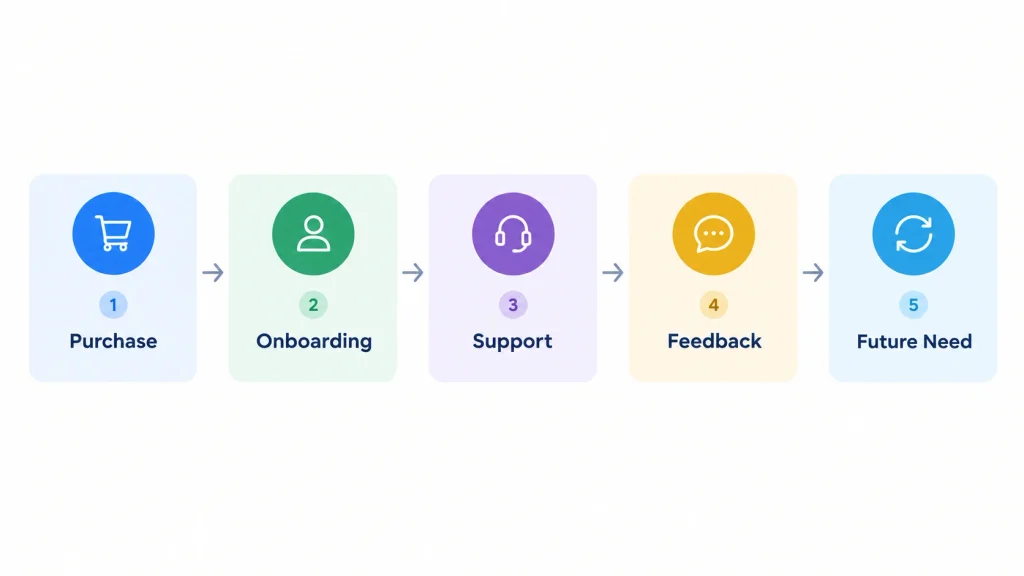
For others, it might be onboarding information, maintenance advice, a check-in, product education, or a reminder about something the customer may need later.
The U.S. Small Business Administration has similarly recommended following up with customers after a sale to see how they are doing, answer questions, and identify opportunities to provide additional value.
That is a much better foundation than simply sending another discount.
A Better Post-Purchase Experience Can Be Surprisingly Simple
Imagine you run a small web design business.
A client launches their new website on Monday.
You could simply send the final invoice, confirm that everything is complete, and disappear.
Or you could create a more useful experience.
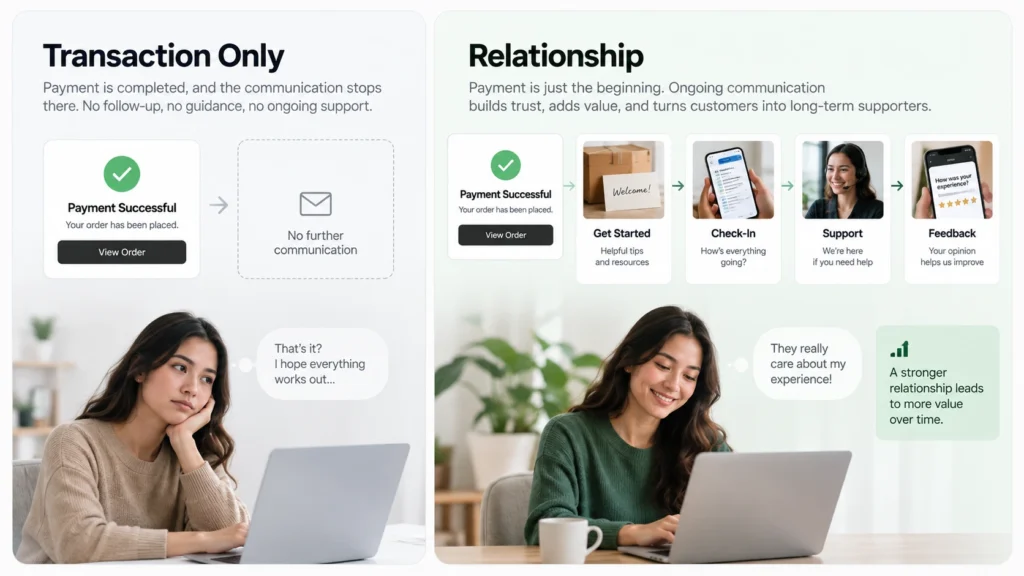
A few days after launch, you could check whether they are comfortable using the website. A few weeks later, you could ask whether they have noticed anything that needs attention. Later, you might share a useful resource related to website maintenance or performance.
None of those messages has to be a sales pitch.
They communicate something more important:
“We still care about what happens after delivery.”
That feeling can become part of your brand.
Don’t Turn Customer Relationships Into Constant Promotions
There is a difference between staying connected and constantly trying to sell.
If every message after a purchase says:
“Buy this.”
“Upgrade now.”
“Here’s another offer.”
“Don’t miss this deal.”
the relationship can quickly start feeling transactional again.
A better approach is to make the communication useful first.
For example:
If you run a skincare business, you might send guidance on caring for a product the customer already purchased.
If you run a professional service business, you might send a useful reminder about a common issue customers face after the project is complete.
If you operate an ecommerce store, you might explain how to get the best use from a product before recommending something related.
The next purchase can happen naturally when the customer’s need returns.
Customer Feedback Should Be Part of the Relationship
Post-purchase communication is also an opportunity to listen.
You do not need a complicated survey after every transaction.
Sometimes one simple question is enough:
“How did everything go?”
The answer may reveal something you would not have noticed internally.
Perhaps the checkout process was confusing.
Perhaps the onboarding instructions were unclear.
Perhaps the customer expected something different.
Perhaps the product worked well, but they struggled to understand how to use it.
Customer feedback becomes much more valuable when you actually use it to improve the experience.
Research and business guidance around customer loyalty repeatedly emphasize the importance of listening to customers and using feedback to improve the relationship rather than treating loyalty as merely a rewards program.
Not Every Customer Needs the Same Follow-Up
One of the easiest mistakes is creating one generic follow-up sequence for everyone.
A customer who purchased a $30 product does not necessarily need the same communication as a client who invested thousands of dollars in a service.
The timing may also be different.
Consider the difference between:
- A one-time purchase
- A recurring service
- A project-based engagement
- A subscription
- A product that needs education
- A service that naturally leads to future work
The relationship should reflect the customer’s actual situation.
That does not necessarily require sophisticated software. Even a simple customer list with a few useful categories can help a small business communicate more thoughtfully.
Your Website and Email Should Work Together
This is where the customer relationship becomes a digital strategy issue.
Your website handles discovery, information, trust, and conversion.
Email can help continue the relationship after conversion.
For example, a customer might first discover your business through a search result, visit your website, review your services, and make a purchase.
After that, the website is no longer the only digital touchpoint.
Email can help with onboarding, education, follow-up, reminders, feedback, and relevant future communication.
The important part is that these channels should feel connected.
A customer should not receive an email that feels completely unrelated to the experience they just had on your website.
Retention Does Not Mean Chasing Every Customer
There is another important distinction here.
The goal is not to hold onto every customer at any cost.
Some customers are simply not a good fit.
Others may only need your service once.
Some relationships naturally end.
Customer retention becomes unhealthy when a business starts making decisions based only on keeping people from leaving instead of improving the value it provides.
The better question is:
Are we giving the right customers a good enough reason to continue choosing us?
That shifts the focus from chasing people to improving the relationship.
What Small Businesses Can Do This Week
You do not need to rebuild your entire marketing system.
Start with the customers you already have.
Look at the last few customers who purchased from you and ask:
- What happened immediately after payment?
- Did they receive enough information to get value from what they bought?
- Did anyone check whether they were satisfied?
- Is there a logical reason to contact them again later?
- What could we teach them that would genuinely help?
- What feedback could improve the customer experience?
- If they need something related in the future, will they remember us?
The answers will probably reveal a few simple opportunities.
Maybe you need a better thank-you email.
Maybe you need an onboarding sequence.
Maybe you need a 30-day check-in.
Maybe you need a useful newsletter instead of promotional emails.
Maybe you simply need a process for following up with important customers instead of relying on memory.
The Real Growth Opportunity Is Not “Sell More”
There is nothing wrong with wanting repeat business.
But the strongest customer relationships are usually not built by asking for another purchase immediately.
They are built by continuing to provide value.
When customers feel that a business remains helpful after payment, the relationship becomes more than a transaction. Over time, that can create opportunities for repeat business, referrals, feedback, and stronger customer trust.
Bain’s research on customer experience and loyalty has similarly connected strong customer relationships with behaviors such as repeat purchasing, referrals, and lower likelihood of defection.
The exact outcome will differ by business, but the underlying principle is useful.
Don’t disappear simply because the money has changed hands.
What This Means for Your Business
For a small business, customer relationships are one of the areas where a little more thought can make a meaningful difference.
You do not need a massive loyalty program. You do not need to email customers every week. You do not need another complicated marketing platform just because someone told you that you need one.
Start with the relationship you already have.
Ask what the customer needs after the transaction, what would make their experience better, and what useful reason there is to stay connected.
If the answer is clear, build a simple process around it.
And if your current website, email system, or customer journey makes that difficult, that is worth fixing before adding more marketing on top.
The goal is not to keep selling to people who have already bought.
The goal is to give good customers a reason to remember why they chose you in the first place.